For 18 primary and elementary schools in Juja, Kenya, school lunches are an investment with a huge return – the equivalent of nine dollars in benefits for each dollar invested.
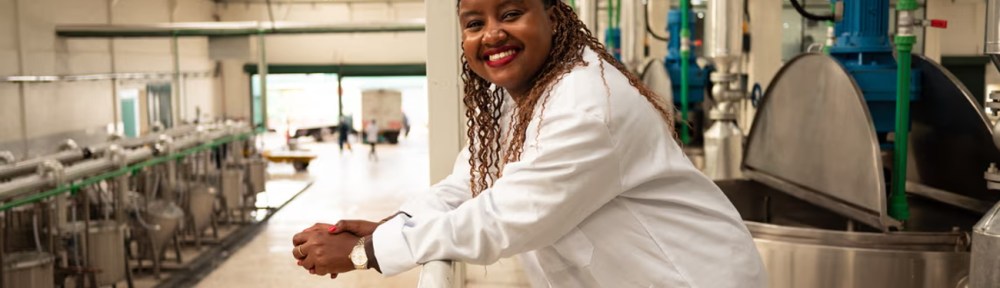
At 4 a.m. each school day, in a centralized kitchen run by Food4Education, kitchen workers chop bags of onions, carrots, tomatoes and cabbages to add to lentils, beans, or rice. The kitchen – which the Guardian describes as “the largest green kitchen in Africa” – provides daily nutritious meals for 60,000 students at preschool and elementary schools in Nairobi.
The huge kitchen runs sustainably, using eco-friendly scrap wood briquettes to run two boilers to heat water and create steam.
School feeding is about equity and making opportunity universal, says Ruth Muendo, impact manager with Food4Education. “It meets fundamental needs. And it allows us to match the opportunity to learn with the ability to learn.” In Kenya, the meals are disrupting generational poverty, and they have become vital as drought increases food insecurity.
The kitchen—run by the nonprofit Food4Education and supported by The Rockefeller Foundation as part of a grant to the World Food Program—means that one quarter of the students enrolled in Nairobi’s state schools now get at least one hot meal a day. Most of them come from poor city neighbourhoods.
“For every one dollar invested in school feeding, the return is about nine dollars—from jobs, to long-term health, to social impact, the need for correctional facilities,” says Muendo. “Clearly, the gains outweigh the costs.”
It is a long way from Australia, where Wawira Njiru was a 21-year-old nutrition and food sciences student when lectures about how bad nutrition affected African children pricked her conscience. With some personal savings and funds raised by cooking Kenyan meals for her Australian friends, she built her first kitchen, close to the local school in her home town of Ruiru, 20 km from Nairobi, in 2012, and fed 25 school children.
In 2017, Njiru visited the Akshaya Patra Foundation, an Indian school lunch programme started in 2000 in Bengaluru, Karnataka. By 2022, it was feeding 2 million children daily. “I saw the structures including procuring processes, accounting and human resource management. I had none of those,” she says. Since putting those structures in place and creating a dedicated team, Food4Education has been able to prepare and deliver more than 21m meals to date.
In February 2023, it expanded its kitchens so it could serve five times the number of meals it had a year earlier, Njiru said. Now it is the largest school meals programme in Africa, operated in partnership with the national government and several county authorities, which offer subsidies that make meals more affordable for parents.
Food4Education uses centralized kitchens and cutting-edge technology; aims to avoid waste, recycles bottles and paper and passes organic waste onto farms; and sources food directly from local farmers.
“We are keen on ensuring that local economies grow,” Muendo said. “The centralized kitchens allow us to be efficient and buy food at scale.”
It also supports regional employment. “Some 70 to 80% of our 710 employees are women,” says Muendo. “And we usually hire women who live locally to empower the community and create a sense of ownership. We have turned a normal household chore—cooking—into something that can give them an income. We also pay above the minimum wage to show we have the interest of the people at heart.
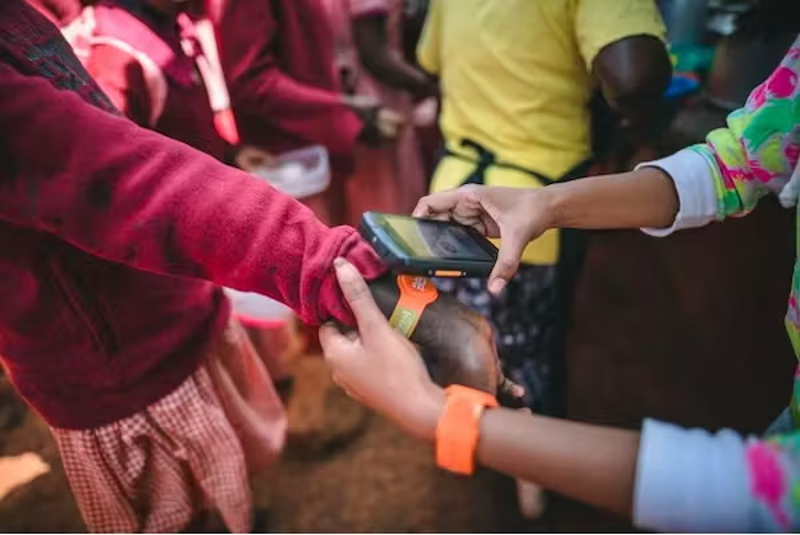
At school, the students wear a bright orange smart wrist band, which is linked to a virtual wallet. Parents contribute the equivalent of 15 cents per day for a subsidized lunch that would normally cost 50-70 cents, using mobile money. The amount is credited to a virtual wallet linked to an “NFC-technology” enabled smart wristband, which students use to then ‘tap to eat’ in under 5 seconds.
Today, 1.6 million Kenyan children in arid and semi-arid areas receive school meals, while 8.4 million go without. In October 2022, Kenya’s Parliament directed the Ministry of Education to develop a school feeding policy to cover all students in basic education. And in April, Kenyan President William Ruto said the national government would match funds with every county government that provides such programs.
An analysis of the effects of adding school lunches at Kuraiha primary school has resulted in an increased enrollment from 1,200 to 1,800 pupils, as well as improved test scores, and a better sense of security since the students don’t have to leave school grounds to get lunch, said Kuraiha Deputy Headmaster Steven Ndirangu.
Sources:
Kenya’s new urban school meal plan is ambitious – it could offer lessons for scaling up Conversation, Sep. 18, 2023
Food4Education website
Kenya’s School Meals Disrupt Generational Poverty and Improve Community Outcomes Rockefeller Foundation case study
Lunch is served: meet the team behind Nairobi’s vast school meals kitchen Guardian, Nov. 10, 2023
Kenya’s Home Grown School Meals: A Success Story World Food Program. Updated May 19, 2021
Cover image: Photo of Wawira Njira, founder of Food4Education (Edwin Ndeke, Guardian)
 Hopebuilding