The Mowachaht/Muchalaht First Nation, with help from University of Victoria researchers, wants to use the ocean to help power its community so that people who were moved out by the federal government in the late 1960s can return year-round.
Only one family now lives in Yuquot, on Nootka Island. It is known as the birthplace of British Columbia because it was the first point of contact between First Nations people and Europeans. “This village was a trade hub — a place of great wealth sought after by our European visitors,” says Azar Kamran, the nation’s administrator and CEO.
“Moving forward we want to establish Yuquot as a ‘centre’ once more — now in the context of setting examples for innovation in community building and clean energy development.”
That’s why they’re looking to create a renewable energy microgrid powered by the ocean waves, with help from the University of Victoria’s Pacific Regional Institute for Marine Energy Discovery (PRIMED). Using $1 million in funding from the 2022 TD Ready Challenge, the team is customizing existing technology to the wave conditions on Nootka Island.
“This is such an exciting, pure and wonderful example of an Indigenous-led, community-based resurgence through clean energy,” said Brad Buckham, chair of UVic’s mechanical engineering department and co-director of the institute.
Buckham is one of three researchers with the University of Victoria’s West Coast Wave Initiative who developed a computer model of the B.C. coastline, which – combined with years of data from wave measurement buoys – resulted in the most high-resolution wave resource assessment yet available for BC, and revealed several ideal locations for wave energy development.
Researchers from the PICS 2060 Integrated Energy Pathways project found that the integration of a 500 MW wave energy farm has the potential to reduce Vancouver Island’s dependency on annual electrical transmission from the Lower Mainland by up to 11%, and reduce peak winter demand by up to 15%.
Wave energy, especially for small-scale and close-to-shore projects, is more predictable than other types of renewables, such as wind or solar, and generates the most energy in winter, when electricity demand is typically at its highest, he said.
The technology involves floating platforms close to shore attached to lines that move with the swells. The energy is then transmitted through the lines to a nearby electric facility on land that distributes it to households or buildings.
This system, designed by South Korean project partner INGINE, doesn’t rely on costly underwater submarine cables or expensive ocean equipment systems, which reduces the construction and operating costs by a third compared to other wave energy systems. INGINE’s technology is receiving interest as a key solution to enable the energy transition in other remote areas globally.
Work on the Yuquot project has been underway for two years, Buckham told the Vancouver Sun, and the intent is to get the project ready for full construction over the next two years, Buckham told the Vancouver Sun this past spring.
Sources:
UVic researchers help First Nation on Island’s west coast to harness wave power Times-Colonist, Mar. 7, 2023
Coastal First Nation’s ocean-wave energy project just got a million-dollar boost Vancouver Sun, Mar. 9, 2023
INGINE Deal with Muchalaht First Nation to Prepare the Installation of Wave Energy Converter. Ingine, Aug. 3, 2021
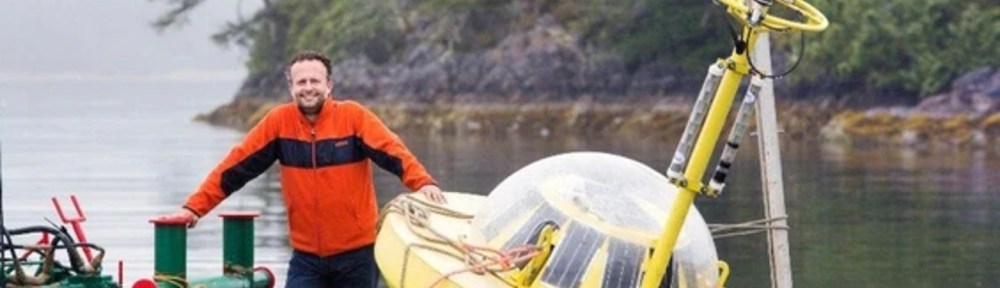
Cover image: Brad Buckham of the University of Victoria’s Pacific Regional Institute for Marine Energy Discovery with a buoy used to collect ocean energy data. Photo – University of Victoria /Local Journalism Initiative
 Hopebuilding