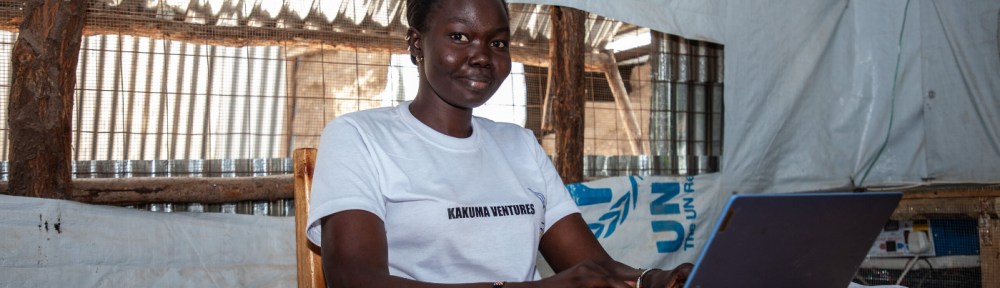
A refugee entrepreneur has brought solar-powered internet access to one of the world’s largest refugee camps, helping more than 1,500 people get online.
Innocent Tshilombo’s award-winning Kakuma Ventures supports entrepreneurs across Kakuma camp to set up and manage WiFi hotspots in their own neighbourhoods. It also has trained more than 60 young people in computing and solar engineering skills and helped them with job opportunities.
In 2022, Kakuma Ventures won an Ashden Award for Energising Refugee Livelihoods.
Entrepreneurs buy a solar home system and WiFi equipment on credit from Kakuma Ventures, then sell internet subscriptions to their neighbours. After the subscriptions have paid off the cost of the equipment, they generate an income for the entrepreneur.
Internet access is boosting enterprises across the camp – from shops to graphic designers – as well as the education of more than 400 students. The organisation has also recently launched a digital listing platform for businesses based in the camp, allowing them to trade online.
“When I joined, I had an opportunity to study and work at the same time,” says refugee Conzana Cornelius, who is Kakuma Ventures’ operations manager. “I was raised by a single mother in the camp and I feel empowered because I can contribute to the running of my home.”
“Kakuma Ventures is the pillar of the digital ecosystem of the camp, supporting our graduates to take the next step,” says Honore Ebengo, of the non-profit ADIYD2.
This year, another venture in Kakuma won an Ashden Award – this time for Powering Refugees and Displaced People.
Since 2021, USAFI Green Energy have been producing affordable, efficient ‘Silver Bora’ brand cook stoves. The stoves, sold through a network of retailers across the camp, cut the amount of time users have to spend gathering firewood – a task that normally falls on girls and women.
It produces more than 100 cookstoves a day at its Kakuma factory. As well as stoves for home, the company makes larger devices for schools and hospitals. The stoves can be fueled by wood, but can also use clean burning briquettes, also made at the camp.
The briquette ingredients include prosopis, an invasive tree species that dominates local vegetation, shrinks grasslands and is a danger to people and livestock – it sucks water from the ground, while cattle are scratched by its thorns and can be poisoned by its seed pods.
USAFI Green Energy replants the areas where it cuts the prosopis with more beneficial mwarubaini trees. It grows seedlings which are given to the community for free – more than 2,000 have been handed out so far.
USAFI Green Energy employs 35 people to manufacture its cookstoves, and contracts another 90 to manufacture the briquettes. 95% of its staff are aged under 35, and 40% are women.
Irene Nandudu, who had worked as a hairdresser in her native Uganda, is using her job making cookstoves to save the money to start her salon business in Kenya, and support her children who are still back in Uganda.
Agnes Kiri, who runs a small café, says the stove’s fuel efficiency and quick cooking time mean she can cook in the same room where her customers eat meals.
Supa Agule is the supervising cook at Kakuma Reception Centre. Her team use large USAFI Green Energy cookstoves to feed over 3,000 refugees three times a day.
“We used to experience a lot of smoke and heat from this kitchen and most staff fell sick often due to these conditions,” she says. “This is before we installed these large low carbon cookstoves.”
Cover image: Conzana Mangati is the Operations Manager for Kakuma Ventures (Ashden Awards photo)
 Hopebuilding