
Shantha Bloemen first saw Hambas in China when she worked there for UNICEF. Seeing women’s mobility challenges in Zimbabwe, she came up with the idea of importing the tricycles from China, where they are widely used.
Now she runs Mobility for Africa, a social enterprise that brings affordable solar-powered electric transport solutions to rural communities. Known as “hambas” from the Ndebele word for “go”, the tricycles can carry loads of up to 400 kilograms, powered by a swappable lithium-ion battery that lasts about 100 kilometers on a single charge.
The tricycles are imported from China as kits and then assembled and modified to suit local conditions at a factory in Harare.
Bloemen and the late Felicity Tawengwa founded Mobility for Africa in Harare in 2019. They focused on “introducing a fleet of tricycles designed for women, setting up a system of battery swapping, using off-grid energy, and you then use shared ownership models with groups of women renting the tricycles – now with, also, a lease-to-purchase model – on a monthly basis.
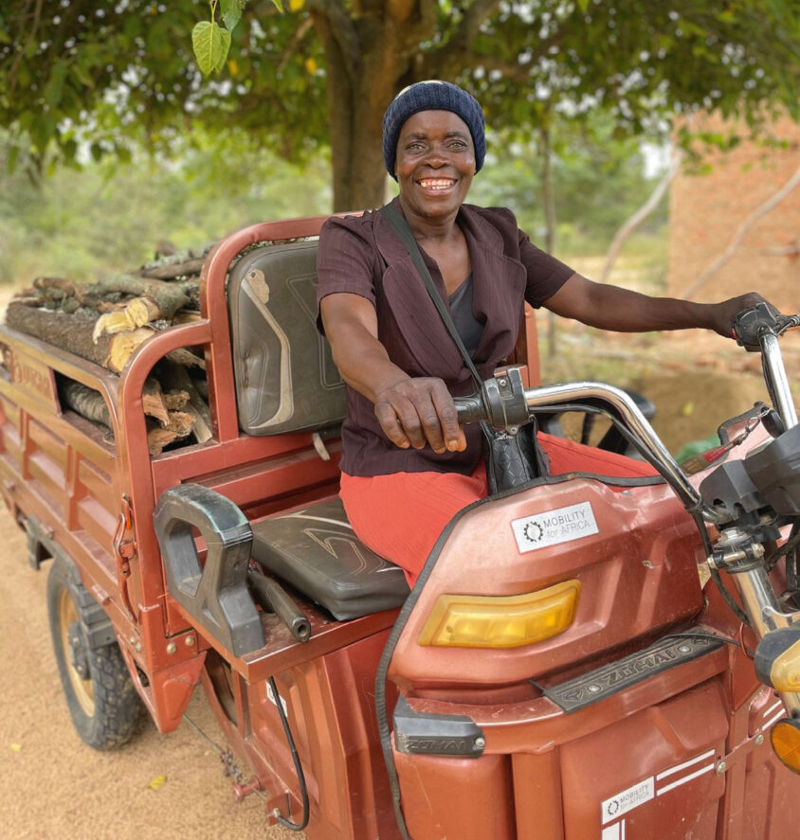
Mobility for Africa charges a fee to swap a battery, and offers a “mobility-as-a-service” model, for groups to rent the tricycles on a monthly basis.
Their 190 Hambas serve three communities, with a charging station in each. The service is designed for areas with a limited electricity supply, where power might reach a town or village centre, but not individual households.
Hambas are designed for women – drivers and riders don’t need to straddle the vehicle.
As a rural woman from Wedza, where the Hambas were introduced in 2019, 53-year-old Adefi Mtambo never imagined she’d be driving a taxi powered by the sun. She used to operate an ox-drawn cart.

“Traditionally a woman’s place has been at the mother seat,” Mtambo said, referring to the front passenger seat of a vehicle. “We were not expected to be in the commanding position. But we are now drivers: we are now steering the vehicle.”
While challenging gender norms has not been easy, especially in rural areas, Philis Chifamba, says it has helped her and her husband, Eric Mudoti, in many ways. “After work as a taxi driver, when I get home I can use the remaining power to fetch water and gather firewood for household use.”
The hamba means she can transport 50 heads of cabbage, earning $50, much more than what she could earn if she had to carry them to market by hand.
“We realized that rural women had a burden of doing almost all of the work,” says Marilyn Maponga, MFA’s research and community engagement coordinator. “They have got the house chores and they also have to do productive work in their gardens, in their farms, as well as going to markets and fetching water. Giving them transport was going to make them more time-efficient and make them more productive.”
The hambas also serve the whole community.”When we have medical emergencies in the middle of the night, I can offer transport to go to the hospital,” says Mtambo.
In rural Zimbabwe, many poor women may have to walk up to 30 kilometers to get to the nearest clinic despite being pregnant. Others are transported in wheelbarrows and scotch carts. Lack of transport to reach health facilities pushes some women to opt to deliver at home.
“If it was not for the Hambas, I would have walked to the clinic. After delivery I was expected to also walk there for checkups with the baby strapped on my back,” says subsistence farmer Talent Zindi, 21, whose family’s monthly income is just Z$3300 ($30).
Thanks to a recent investment by InfraCo Africa, MFA will introduce at least 400 hambas, 600 batteries and eight new charging stations in the coming year. Its achievements were also noted by the Ashden Awards – it was a finalist in the Powering Agriculture category, which noted that
women are using their Hambas to get milk and other products quickly to market.
Sources:
Mobility for Africa. Ashden Awards
(Hello Africa) Rural women drive Zimbabwe’s green transition. Xinhua, Jun 1 2023
Weekend Read: Planning a Hamba-lution. PV Magazine, Sep. 2, 2023
How rechargeable tricycles are saving pregnant mothers and newborns in rural Zimbabwe. Nigeria Health Watch, May 3, 2021
Cover image and photos: Mobility for Africa.
 Hopebuilding