
There is a lovely story in the Christian Science Monitor about Palmwag, a small town in Namibia that hasn’t lost a single one of its rhinos to poachers in three years.
Namibia’s Kunene Region is a vast, rugged, and remote wilderness, home to a unique population of rhinos – the desert-adapted South-western black rhino (Diceros bicornis bicornis), which have roamed the arid landscape for millennia. They are incredibly tough, able to go several days without drinking, and are one of the few animals that can feed on the highly toxic Damara milk-bush (Euphorbia damarana).
During the 1970s and 80s, drought and poaching took a heavy toll on the region’s desert. By 1982, the black rhino population had been reduced to fewer than 40 individuals surviving in Damaraland and fewer than 10 in Kaokoland to the north.
Save the Rhino Trust was formed in 1982 to save these animals from the brink of extinction. Its approach was simple but highly effective: offer local people a more secure livelihood as wildlife guards. Three decades on, the region is home to the last truly wild population of any rhino species on the planet. Namibia itself hosts almost 35% of the world’s remaining black rhino population, and 84% of the South-western subspecies.
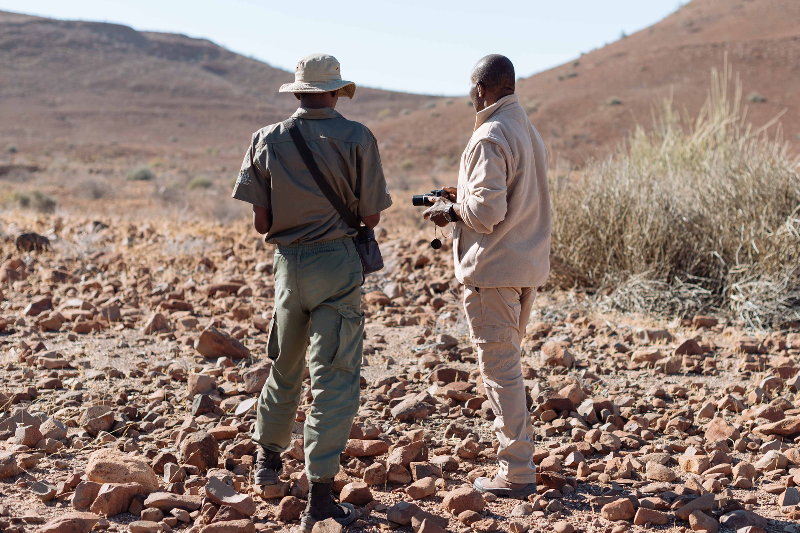
“Every day and every night, trackers from Save the Rhino Trust, alongside rangers from the local community, patrol 25,000 square kilometers (just under 10,000 square miles) in Namibia’s northwest, the only place in the world where this desert-adapted subspecies of the black rhino is still truly wild,” the Christian Science Monitor story says.
The trackers identify specific animals from their behaviors, roaming patterns, and physical features like birthmarks, and document them on small pieces of papers which are creating a living database at the trust’s headquarters in Palmwag.
Namibia’s community conservation model has made safeguarding the animals more lucrative than selling them on the illegal market. One fifth of Namibia is made up of 86 communal conservancies – lands with defined borders and governances, outside the national parks, where the communities themselves benefit from the resources, including animals, on their homelands. Many of these conservancies run lodges that draw tourists, in turn fueling local economies.
“Community conservancies in Namibia are groundbreaking and incredibly powerful and positive, and really leading the way in bringing people who live with wildlife to have a meaningful participation in the way that wildlife is managed,” says Jo Shaw, CEO of the United Kingdom’s Save the Rhino International (a separate organization in Namibia). “It’s just such an important and positive model for Africa … creating that positive link between people and wildlife that is so often missing elsewhere.”
Simson Uri-Khob, CEO of Save the Rhino Trust, won the Prince William lifetime achievement award in 2021 in recognition of a career dedicated to conservation. He says that this work is not just about the local economy.
When he did his master’s degree and asked community members hundreds of questions to gauge their attitudes, he found that people here are simply attached to a creature that has always roamed this land. “We are proud because the rhinos are here, but they are not everywhere,” he says. “We managed ours from near extinction.”
Sources:
How a tiny town in Namibia saved its beloved rhinos. Christian Science Monitor, Jan 25, 2024
Namibia: Save the Rhino Trust website.
Cover image: Charles J. Sharp, Wikimedia Commons
 Hopebuilding