
Retail stores, restaurants, and fulfillment centers who squeeze everything they can out of frontline workers and offer as little in return as possible struggle with constant worker turnover, low productivity, and poor worker morale. It’s a vicious circle.
But companies can make different, better choices, says Zeynep Ton, a professor at MIT’s Sloan School of Management. Companies that implement a “good jobs strategy” have seen large drops in employee turnover and higher worker productivity, and jumps in customer satisfaction and sales.
The Good Jobs Institute, which she helped create in 2017, has become a lab that allows the team to apply her academic research in real life to improve the lives of low-wage workers in a way that helps companies.
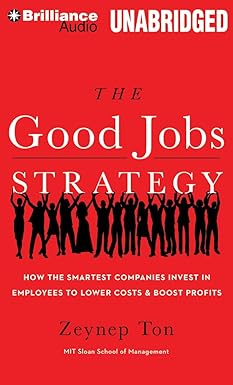
After her book, “The Good Jobs Strategy: How the Smartest Companies Invest in Employees to Lower Costs and Boost Profits,” was published in 2014, many business leaders sought her out to ask for help in implementing these jobs.

At first, having four kids and a full time job, she turned down these requests. But then Roger Martin, the former dean of Rotman Business School, pointed out that if she wanted to see change, she had to figure out how to help. That led them to found the nonprofit Good Jobs Institute.
“Our mission is to help companies thrive by creating good jobs, but another part is to change the conversation about what it means to have a successful company and what is the role of employees in organizations,” Ton says.
Business leaders from Jim Sinegal of Costco, the world’s second largest retailer, to a startup, share that the good jobs strategy is just ‘good business’. And they are touched by the impact the strategy has on employees.
Tim Simmons, the chief product officer at Sam’s Club, saw the strategy’s impact while touring a club in 2019 with a regional manager who was announcing the first pay increases. People began to cry. Some later reported they no longer had to work a second job. Many said it changed their lives.
“Our students, future leaders, not only have the opportunity to create great businesses and do well for themselves and their families, but also to change the lives of so many people for the better,” Ton says.
“The whole idea of the good jobs strategy is you invest in people, and you make choices that make their work more productive and enable higher contributions,” she says. “Without the work design changes, investment in people is unlikely to pay off.”
The Good Jobs Institute has worked with dozens of companies, including owners of convenience stores, retailers, call centers, restaurants, and pest control businesses. Companies that adopt the system report big drops in employee turnover — between 25 and 52% —along with significant increases in productivity and sales.
Ton believes most people underestimate the impact a small pay raise can have on a low-wage worker’s physical and mental health, and that conviction has grown as she’s heard from the companies she’s worked with.
One former student, Michael Ross MBA ’20, SM ’20, has come to Ton’s class to discuss his experience implementing the good jobs strategy at the pest control company he leads. “He talked about how he was in the Marines before and had a deep sense of purpose. Then he went to a private equity firm and missed that purpose and missed making a difference, and now spreading good jobs has become his purpose,” Ton says.
“At a personal level, for leaders at many companies we’ve worked with, the change has been super meaningful,” Ton says. An employee at a restaurant that adopted the good jobs strategy told the owner it allowed her to buy back-to-school clothes from somewhere outside of Goodwill for her children for the first time.
Last year, she wrote about what she’s learned from working with companies, “The Case for Good Jobs,” and the institute is currently working to create a more scalable model of its workshops so the approach can spread more quickly.
“We still have a huge chunk of people who don’t make enough money,” Ton says. “We still don’t have enough respect for the work that frontline employees do, from factories to retail stores to health care settings. That’s one of the reasons why people are fed up and looking for other opportunities. It’s what we’re trying to change.”
Sources:
This nonprofit is proving that creating good jobs is good business MIT News Jan. 12 2024
Good Jobs Institute website
Business leaders talk about the benefits of the Good Jobs Strategy YouTube, Nov. 22, 2017
The Good Jobs Strategy: Zeynep Ton at TEDxCambridge 2013. TEDx Talks, Sep. 25, 2013
 Hopebuilding