A Canadian ‘volunteer cuddle program’ that helps sick babies heal has inspired a program to cuddle babies in intensive care incubators in a hospital in Argentina.
It began at Southlake Regional Health Centre in Newmarket, Ontario, in 2012, when a colleague asked Sandra Payne, nurse educator for NICU and pediatrics, to come in and hug a baby whose parents could not be at the hospital.
Isolettes (self-controlled incubators) house the babies who are too sick, too weak and too small to go home. But they still need to be held. “Being held by a caregiver is a natural, no-cost intervention,” says Payne. “A baby cries, you pick it up. It’s humbling to see how effortless it can be; I just want babies to be held and be comforted.”
It reduces stress, stabilizes heart rates, reduces pain and supports brain development. It can also reduce pain during procedures—babies cry less and appear less agitated. Touch helps babies self-regulate, stabilizing their heartbeats and breathing patterns.
When mothers can’t be at the hospital, a small team of carefully selected, highly trained volunteers cuddle their babies. Payne developed the volunteer training program, and worked with the Canadian Association of Paediatric Health Centres to share guidelines with hospitals interested in implementing their own cuddle programs.
“There have been more than 600 studies in the past 40 years about the powerful effect touch has on babies,” she says. “These studies show how skin-to-skin contact increases the development of essential neural pathways, accelerating brain maturation and allowing babies to spend more time in quiet sleep, which decreases stress hormones.”
The information about that Canadian program made its way to the Provincial Maternity Hospital of Cordoba, in Argentina, which has 50 volunteer ‘huggers’ – 49 women and one man – who donate their time to embrace premature or underweight babies. More than 200 applicants are on the waiting list.
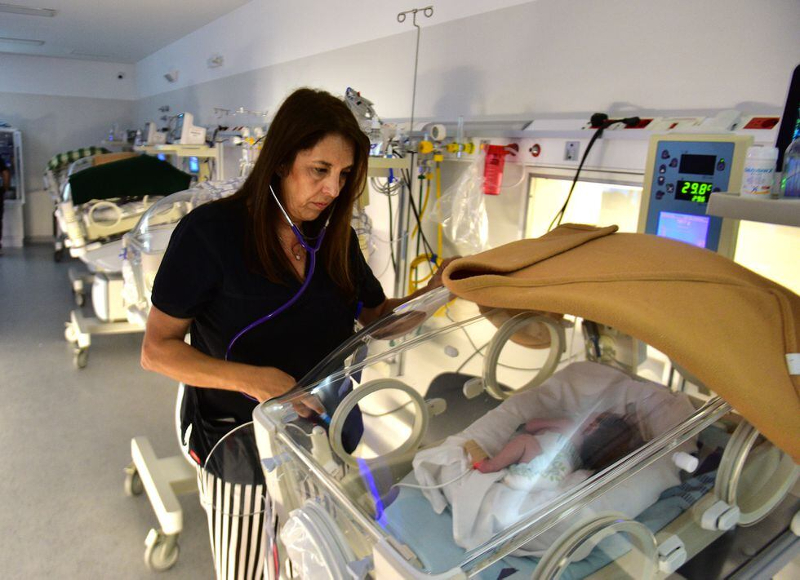
The mothers are absent because they have passed away, have limited economic resources, live far from the ward, have other children, are incarcerated, are victims of domestic abuse, or are addicted to substances.
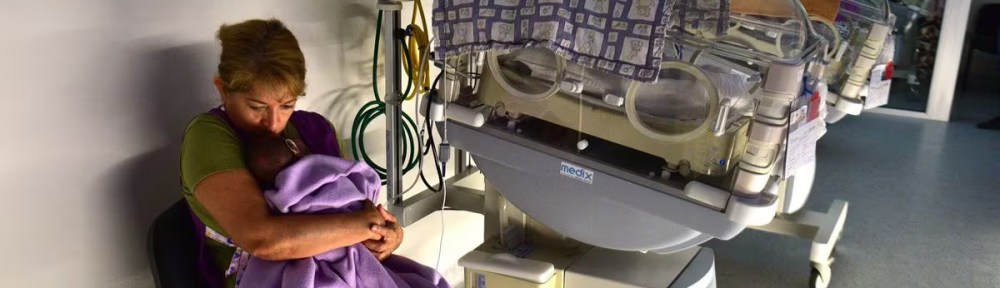
“I want [the babies] to be certain that, since they were born, they’ve been loved and accepted. It’s amazing how [valiant] they are, they have such a desire to live,” says 60-year-old Irma Castro, a retired teacher who has been a volunteer for more than two years.
About 1,500 babies – of the 5,200 born each year – need intensive care and about 15% of them need to be hugged, says Nancy Sánchez Zanón, head of the Maternity Neonatology Department.
The project to incorporate families and the community began in 2010, within the framework of volunteering in “safe and family-centered maternity wards” in the public hospitals of Córdoba. It replicates a strategy promoted in Buenos Aires by the Ramón Sardá Mothers’ and Children’s Hospital, together with UNICEF.
“The healthcare team cannot do it alone. With families, it adds up, and with the community, it adds up even more,” says program coordinator Ana María Rognone, who is head of intermediate care at the Maternity Hospital.
The huggers were incorporated into the program in 2017, after a volunteer shared information about the Canadian program.
The volunteers also tour the wards, noting down the needs of the mother. Marcela Mancardo, a 59-year-old housewife, says that the first baby she hugged hadn’t had contact with her mother due to a health problem. “I was the first to hug her: it was my first time as a volunteer. It was an explosion of love. I cried at home,” she recalls.
Retired architect Susana Sassy, 82, says that, when she holds a newborn, she touches the sky with her hands. “It’s wonderful to hear that little heart beating. Many of us have been mothers, but this is different: you’re committed to a different love. It is giving light, life and love,” she says.
At the end of last year, the huggers were given an award and publicly-recognized by the city of Córdoba. “[It was important to show that], from the outside, you can be in a neonatology room. It’s important to cover for vulnerable populations who cannot be with their baby at that time,” says Rognone. For her, all maternity hospitals should incorporate the community to accompany families. “[Caring isn’t possible] with medicine alone, but with affection.”
Sources:
A volunteer program that’s healing sick babies one hug at a time. Canadian LIving, Oct. 23, 2017
Hug therapy: Volunteers stimulate the development of premature babies in Argentina. El Pais, Feb. 6, 2024
Cover image: Irma Castro hugs a baby next to an incubator, in the intermediate care room of the Provincial Maternity Hospital of Córdoba, Argentina, on January 14, 2024. Phoro by Ramiro Pereyra, El Pais
 Hopebuilding