
Recycling has sparked a phenomenal turnaround in Panama’s largest prison. It is a story that is both so practical and inspiring that it has been replicated in four other prisons in Panama, and the authorities in Honduras, Paraguay, El Salvador, Peru, Colombia and Nicaragua also are interested in the idea.
It began after Franklin Ayón, an agronomist and a recycling expert, was sentenced for drug trafficking in 2012 and sent to La Joyita prison, just outside Panama City. Filthy, overcrowded and dangerous, it was known as the “stomach of the beast”. Prisoners literally lived on top of rubbish in the prison, which accommodated 4,000 prisoners.
“It was everywhere – in the corners, in the corridors,” says Ayón. “We had to sit with a towel over our head to eat, just so the flies wouldn’t land on the food.”
In 2014, Ayón designed a recycling scheme that he called EcoSólidos. “We set ourselves the challenge of turning the problem into an opportunity. EcoSólidos was born in the prison cell blocks. Our motto is the four R’s: reduce, reuse, recycle and – we’ve added one of our own – resocialize,” he said. In exchange for reduced sentences, prisoners would collect, separate, recycle and sell waste.
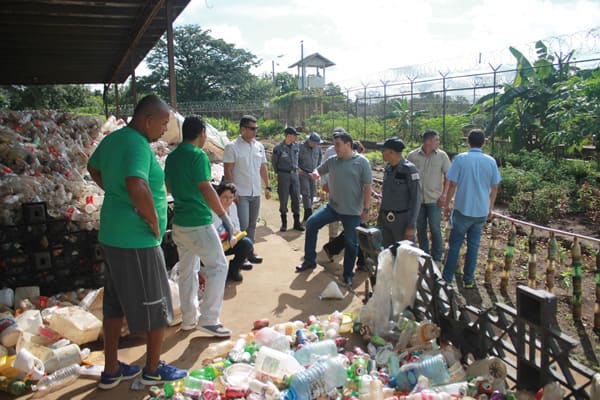
The idea got support from the prison authorities, gang leaders, and the International Committee of the Red Cross, which provides guidance to the prison authorities on prisoner living conditions and hygiene and maintaining and building facilities. (Since the program got underway in 2016, ICRC has provided guidance on how to build capacity at the recycling plant and also provides supplies to keep the program running, such as tools, gloves, boots and bags.)
About 80% of the prison’s waste is now recycled. Plastic and aluminium are sold, while food waste is turned into compost for the prison’s gardens, where fruit and vegetables are grown. The Sembrando Paz (“sowing peace”) nursery, created from an abandoned area, has more than 16,000 seedlings and produces many native trees. Each year, 1,500 tree seedlings are donated to a reforestation scheme run by Panama’s environment ministry.
In 2016, Ayón was granted a presidential pardon for his work and, on his release, he created a nonprofit organisation, GeoAzul, which employs former inmates who have been part of the EcoSólidos Resocialization Programme in La Joyita Prison. GeoAzul is the largest labor reintegration company in Panama and the only organic waste manager in the municipality of Panama and San Miguelito.

On average, GeoAzul collects and processes more than 10 tonnes of urban waste in Panama City. It employs former prisoners, who earn a monthly salary and gain a reference which helps them find other jobs. Since 2016, about 800 people have worked with the company, saving the prison system about $1.2m as most people GeoAzul employs do not re-offend, and benefitting about 3,000 people indirectly.
The rate of reoffending and returning to prison has dropped from 65% to 45% since 2019, Eliécer González, head of treatment and rehabilitation in Panama’s prisons, told the Guardian in 2024. And not one prisoner who has taken part in EcoSólidos has reoffended, he said.
In the prison, morale also improved as prisoners became productive and saw their work helped the environment, and benefited from working in a team and spending time outside. The ICRC says that tensions between prisoners have been eased due to the cleaner environment.
Building on the success of Ecosólidos, the organization is looking to expand the recycling programme. GeoAzul hopes to be the benchmark for prisoners who have been released or are on probation and looking for their first job, using environmentally friendly practices to transform people’s lives.
Through EcoSólidos, participants’ sentences can be reduced hy a day for every two days of work. The program also really supports the reintegration of former prisoners into society. Some ex-inmates who have worked in this program now have recycling companies or work in the Ministry of Environment, says Etéreo Armando Medina, director general of Panama’s penitentiary system.
There have been two sub-programs that have grown from EcoSolidos. As well as the garden centre, “Sembrando Paz, Reforestando Vidas” [Sowing Peace, Reforesting Lives], another by-product is the environmental barriers that are being used to catch rubbish in the country’s rivers, says Medina.
Sources:
Panama: GeoAzul and the EcoSolidos programme – Reduce, Reuse, Recycle and Resocialize ICRC, Aug 6 2022
Multiple investments to transform the Panamanian prison system Justice Trends, Jul 22 2019
Left to rot: how a prisoner cleaned up Panama’s dirtiest jail – and its inmates Guardian, Mar. 7, 2024
Cover image: Etéreo Armando Medina, director general of Panama’s penitentiary system, visits the Sowing Peace, Reforesting Lives centre
 Hopebuilding
“Win-win-win-win” and seems like a no-brainer— every incarcerated individual should have an opportunity to participate in such a program.