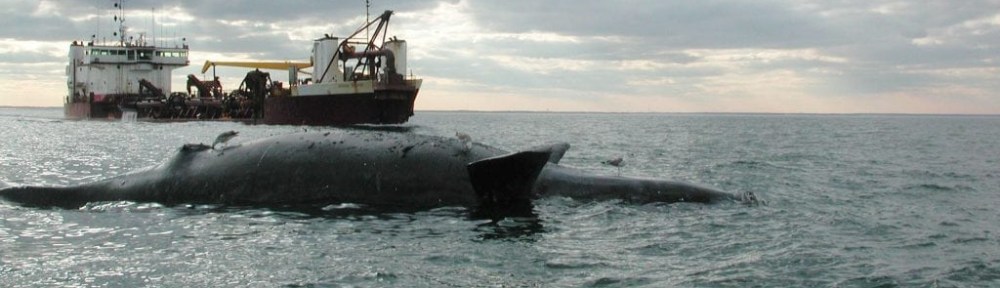
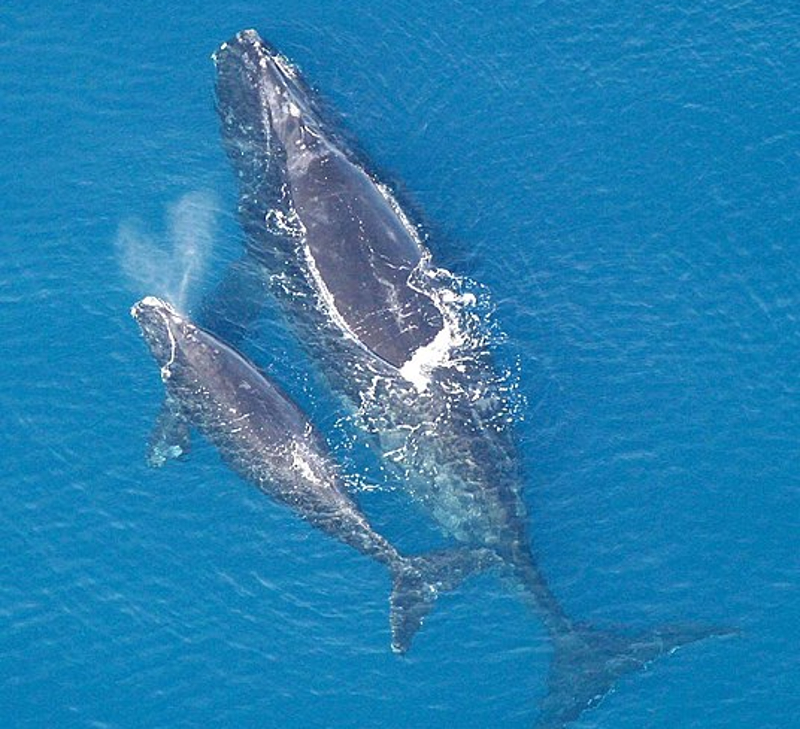
The North Atlantic right whale is one of the world’s most critically endangered species, with less than 400 left, in part because it spends much time in the busy shipping lanes on the east coast of North America and now the Gulf of St. Lawrence. Nearly 90% of right whale deaths between 2003 and 2018 were caused by vessel strikes and entanglement with nets.
But a new scientific development known as bioacoustics has made it possible to protect the whales from ship strikes by using the sounds they make to let ship’s captains know when the whales are nearby. The program triangulates the locations of whales and conveys the information to ship’s captains in real time. The ships then have to slow down, stop, or move out of the way.
“Not a single right whale has died of a ship strike in this zone since this program was launched,” Karen Bakker said in a fascinating TED talk recorded in April 2023 that looked at what scientists are learning about how species communicate in ways humans can’t hear – but which AI is beginning to decipher. And scientists are exploring how such technology could be used more widely in the world’s oceans.
“A few decades ago, we were harpooning these whales nearly to extinction,” she says. “Today, we’ve invented a technology that allows a community of less than 400 whales, simply by singing, to guide the movements of tens of thousands of ships in a watershed that’s home to tens of millions of people. One day, these whale lanes may be everywhere in the oceans. For the orcas who live here in the Salish Sea, this would be just in time because there are only a few dozen left.”
Whale Alert, a situational awareness mobile app that alerts vessel operators on the presence of right whales, was originally created by the Stellwagen Bank National Marine Sanctuary. It was based on more than two decades of work by scientists, government and conservation groups to gather and analyze data on how whale ‘zones’ and shipping vessel traffic interacts.
The Whale Alert app was launched in 2012 as a citizen science tool aimed at reducing the risk of vessel strikes. It uses data including verified sightings, acoustic detections from buoys and gliders, and aerial surveys to display a user-friendly map based on nautical charts from country-specific government agencies. Mariners, scientists, whale watchers, recreational boaters, and beachgoers can easily share whale sightings with the Whale Alert team who verify the information before posting it to the map in near-real time.
As well as the eastern seaboard of the US, Whale Alert is now active on the US west coast, Alaska and Maritime Canada. Partners include Conserve IO, International Fund for Animal Welfare, National Marine Fisheries Service and the New England Aquarium.
“Large whales are vulnerable to collisions with all vessel types, sizes, and classes throughout the world’s oceans,” explains Whale Alert. “As our waterways become increasingly congested, high-traffic areas often intersect key marine mammal habitats. In California, gray whales are the most commonly reported vessel strikes. Along the Atlantic coast, it’s the critically endangered North Atlantic right whale. Regardless of location, these strikes are often deadly for whales and cause significant damage to vessels.”
Launched as a free app for iPads and iPhones, Whale Alert displays speed zone regulations and whale management areas on the US Atlantic coast. Ideally, the app allows whales and ships to share the same waters by making it easier for the shipping industry to comply with existing regulations. Easy-to-read nautical charts with pop-up alerts remind ships in real time that they were entering regulated areas.
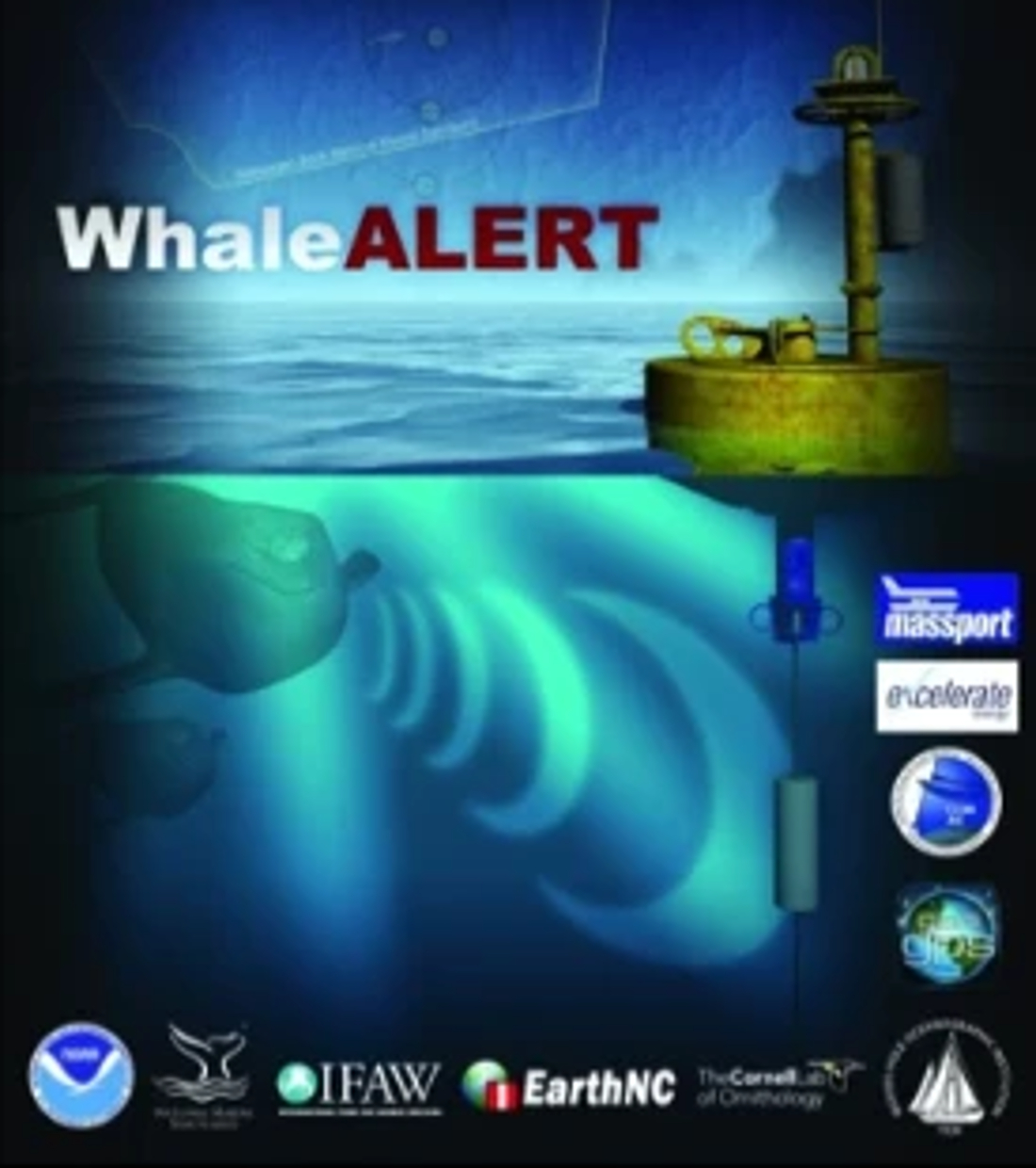
In 2020, University of New Brunswick researcher Kimberley Davies used an autonomous underwater glider equipped with a digital acoustic monitoring device to detect several species of large whales in the Laurentian Channel shipping lanes between Anticosti Island and Cape Breton Island. The collaboration between UNB and Transport Canada was hailed as a success.
Other new technologies to protect the right whales include ropeless fishing gear that could dramatically reduce or eliminate right whale entanglements while allowing fishermen to continue their livelihoods.
Bakker’s brilliant book about how scientists are using groundbreaking digital technologies to uncover such astonishing sounds and reveal communication across the Tree of Life, is called The Sounds of Life: How Digital Technology Is Bringing Us Closer to the Worlds of Animals and Plants. It was published by Princeton University Press in October 2022.
In an interview with Princeton, she talked about how the book grew out of her work to help UBC students who grew up as digital natives understand how so many environmental and climate issues were interconnected and offered powerful new tools to protect the environment.
While people have been listening to nature for a long time and Indigenous groups have long practiced ‘deep listening’, the advent of tiny bioacoustic devices combined with AI are making it possible for people to hear sounds we cannot hear with our ears, and to hear soundscapes, rather than just individual sounds, she said. This means being able to discern signs of health and disease in natural systems.
Her TED Talk helps explain how groundbreaking this is.“About 400 years ago, the inventors of the microscope were astonished to discover the microbial world,” she says. “They had no idea their invention would lead to the discovery of DNA and the ability to manipulate the code of life. Around the same time, the inventors of the telescope were gazing up at the stars, not knowing their invention would allow humanity to look back in time to the origins of the universe. Optics decenters humanity within the solar system, within the cosmos. Bioacoustics decenters humanity within the tree of life. Our commonality is greater than we knew.”
Cover image is from Whales and Dolphins
 Hopebuilding