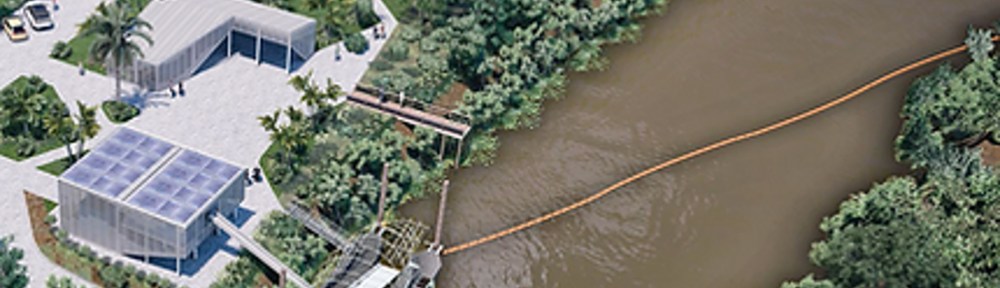
Baltimore’s family of ‘trash wheels’ inspired Latin America’s first renewably-powered, trash-trapping wheel, Wanda Diaz, that is situated on one of Panama’s most important but heavily polluted rivers before it flows into the Pacific Ocean.
Thanks to an initiative by the local environmental group Marea Verde, the wheel, fueled by hydraulic energy and solar panels, collects the vast amounts of waste produced in the capital Panama City with a metro population of around two million people.
Marae Verde started the project in 2017 in their backyard, the Matias Hernández River, because they were tired of seeing tons of garbage drifting down to the mangroves and ocean. But because it was a new idea for Latin America, preparing the pilot project took a lot of work.
They began with mangrove cleanups and research into ways to collect garbage while still in the river, preventing it from reaching the oceans. It took them more than two years to define a system, location, operation plan, and persuade key stakeholders to install a floating barrier.
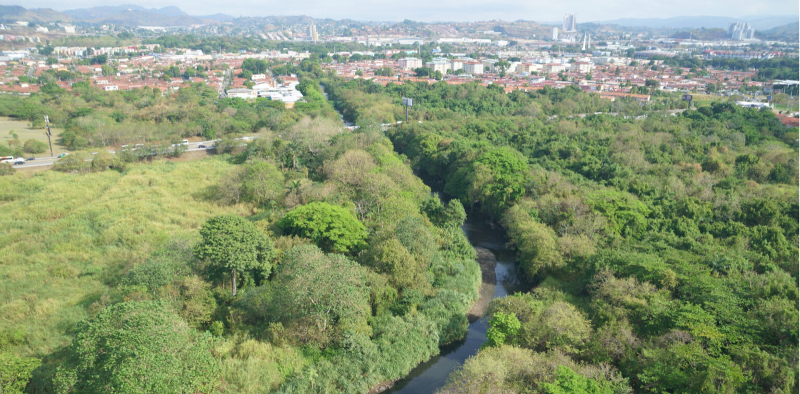
B.o.B (for “Barrera o Basura”, in Spanish; “Barrier or Trash” in English) drew much press attention, particularly after big storms. Marae Verde worked to maximize the barrier’s efficiency in trapping garbage, improving its retention capacity, and removal time from the river. They kept statistics of garbage weight and volume retrieved from the river, generating interesting information for the first time on the type of garbage that flows in a Panamian river.
Between 2019 and 2020, it trapped over 100 tonnes of waste in the Matias Hernandez river. But when the COVID pandemic restricted movement at the onset of the 2020 wet season, neighbours objected. “We were wrong to assume our neighbors shared our goals for a garbage-free wetland and ocean (their larger backyard), particularly as this is a project with no financial burden on them.”
Not wanting to be constantly in conflict with the community, the NGO removed the floating barrier on July 29, 2020 and after having studied three other potential sites, decided to move the project to the Juan Díaz River, one of the city’s largest watersheds. While it is densely populated in its mid and low watershed portions, it has important forest cover in the upper watershed and river origins, and ends in an important Ramsar site and Bay of Panama Wildlife Refuge.
The protected wetland spans over 85,664 km2, and its lagoons, grasslands, floodplain forests, and mangroves are home to more than 295 plant species, 25 mollusks and crustaceans, 200 birds, 74 fish, and 50 mammals. Over 27 species of fiddler crabs have been found, more than anywhere else in the world. Globally threatened species include the American crocodile (Crocodylus acutus), spider monkey (Ateles geoffroyi), giant anteater (Myrmecophaga tridactyla), tapir (Tapirus bairdii), and the tea mangrove (Pelliciera rhizophorae)1.
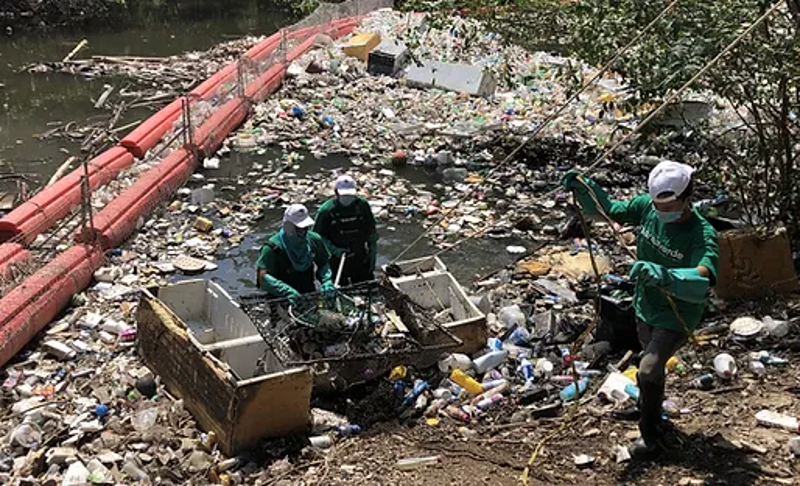
“Cleaning beaches is good, but it is more effective and cheaper to trap garbage in rivers because when it reaches the ocean, the environmental and economic cost becomes too high,” said project leader Robert Getman.
The Wanda Diaz, which launched in September 2022, has a camera system that generates images and data that future projects or public policies can use to prevent pollution of rivers and seas.
“We want to raise awareness that we can prevent the death of this very important river,” said Marea Verde head Sandy Watemberg, expressing optimism that the wheel will help. But she also pointed to the need for those who much too casually use single-use plastics to rethink their own consumption.”The most important thing is to achieve a change in habits,” she said.
One way they are doing this is through a book called Bob y Garzón, Against the Garbage Current, that tells the story of BoB and Garzón who fight to prevent waste and plastic from reaching the mangroves and seas. BoB is a small floating barrier installed as an experiment in the Matías Hernández river and Garzón is a Panamanian heron, BoB’s faithful companion, who flies up and down the river and tells BoB everything he sees.
Sales support a campaign that seeks to donate books to public schools in the communities of the Juan Díaz River Basin. For every book sold, Marea Verde will donate a book to area schools.
Sources:
Panama river cleaned up by trash-trapping wheel in a green first, Reuters, Nov. 2 2022
How a Guatemalan river clean-up could help save the oceans. Fair Planet, Mar 22 2024
Our backyard. Clean Currents Coalition, Jul 9 2021, on Marea Verde website
Cover image: the Wanda Diaz
 Hopebuilding
Kudos to those trying to save the mangroves and ocean! Human behavior around single-use plastics … sigh. As long as they are cheap and widely available people will use them because so many people in densely populated areas are simply trying to survive, don’t have the capacity to care, & won’t be influenced by educational campaigns.