
Almost all collisions with animals on Australian roads are with kangaroos. But now Volkswagen is working on turning its iconic badge into an audio warning that will protect both kangaroos and drivers. And they think that the technology, which now is moving into Stage Four trials involving kangaroos in the wild, may eventually have much wider applicability.
An estimated 10 million native mammals, reptiles, birds and other species are killed each year, experts say. Human deaths and injuries from these collisions also are rising, with motorcyclists at greatest risk.
“Roadkill is a problem all around the world,” says Dr. Helen Bender of the University of Melbourne, whose research was used extensively in the project. “What’s interesting about deer relative to kangaroos is that they’re very similar in body size, head size, and ear size. What we know from science is that the ear shape in the head shape tells us that they probably have similar hearing ranges. So, whatever we learn has transferability to the deer as well.”
The RooBadge, which fits over a Volkswagen’s front badge and emits a warning signal to kangaroo species, was developed over three years by Volkswagen Australia and the DDB Group in consultation with the University of Melbourne and WIRES.
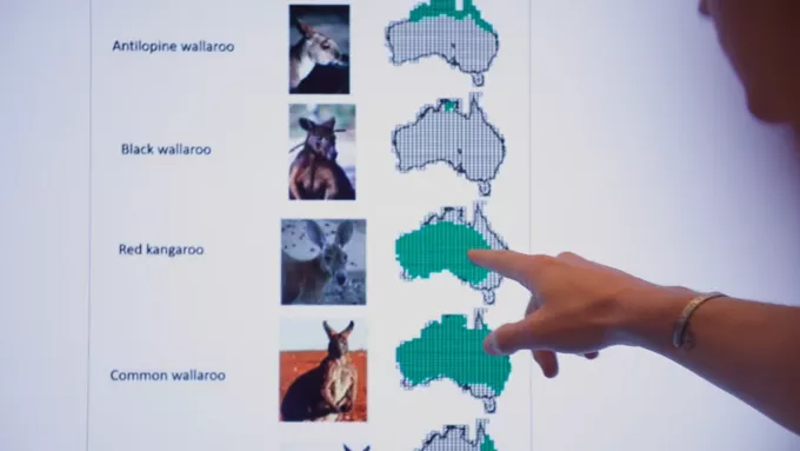
Connecting to an in-car app, RooBadge calibrates a vehicle’s GPS coordinates with specific kangaroo species distribution data, using a unique audio deterrent for the kangaroo species that inhabits the vehicle’s particular location across Australia.

The 4th test phase involves driving slowly to find wild kangaroos. Once spotted and within range, the driver plays a random sound and captures the kangaroos’ reactions on video.
“[RooBadge does] something no kangaroo deterrent has been able to do before,” Melbourne University associate professor Graeme Coulson told LBB Online. “It’s difficult to produce a single sound that will deter all kangaroos, because the species are different to each other. Using advancement in car technology we can change the sound deterrent by GPS location.
“We have worked on sounds that will be meaningful to Eastern Grey Kangaroos, things like dingo calls, alarm calls made by birds and the alarm thumps that kangaroos make to warn each other. We will then be able to tweak the sound for other species.”
The project grew and grew from the idea for a speaker in a VW badge to reduce animal collisions, into an innovative, data and science-driven project, says DDB digital executive creative director David Jackson, who led the project for DDB Sydney.
“By partnering with The University of Melbourne and WIRES we were able to build a protective audio shield that will have real impact on keeping people safe on our roads. We have also worked with The University of Melbourne Office of Research Ethics and Integrity and industry leaders to develop RooBadge through real-world tests to help optimise our hardware, software and sounds,” he said.
And it won’t be just for Volkswagen vehicles, or even just for kangaroos – the company is developing a universally mountable version that will attach to a vehicle’s number plate, enabling a RooBadge to be installed on any vehicle regardless of its manufacturer. And its data-powered technology, which enables it to change sound according to its GPS location, will allow sound to be adapted to deter different animals when driving through another country.
“So, we’re working with partners overseas to adapt RooBadge to deter deer and other problem animals worldwide.”
Sources:
Volkswagen’s ‘RooBadge’ Reduces Collisions with Kangaroos and Wildlife. LLB Online, Mar. 29, 2024
10 million animals die on our roads each year. Here’s what works (and what doesn’t) to cut the toll. The Conversation, Mar 21 2024
Transforming the iconic Volkswagen Badge into a protective audio shield. Volkswagen Australia
Cover image: Sabel Blanco, Pexels. Other photos from Volkswagen Australia website.
 Hopebuilding