Dutch fashion designer Bas Timmer has been designing clothes since he was 16, turning his bedroom into a sewing room and attending a vocational school in the Netherlands.
He designed a hoodie with a scarf, which became famous in the Netherlands. Then, doing a fashion internship in Copenhagen, Denmark, and noticing many homeless people, he thought of giving the hoodies away. But his mother worried that people would stop buying his hoodies if he gave them away for free.
Then he received the shattering news that his friend’s father had died of hypothermia jn the Netherlands while sleeping outside in 8 degree weather, next to a homeless shelter that was closed for the night, and he knew he finally had to do something.
He pulled some materials together (an old sleeping bag and a tent) and in five hours, made a jacket with an additional piece that turned it into a sleeping bag – the first ever Sheltersuit. He took it to a shelter and approached a man sleeping nearby, offering him the suit.
When the man asked if he could share it with two friends, who were living in even worse conditions, Bas promised to return with more. And he did, returning with the first 100 Sheltersuits after gathering the materials, resources and donations required.
The Sheltersuit serves as a jacket during the day, and a sleeping bag at night, and transforms into a rucksack for transportation. The garments are crafted from upcycled textiles, including sleeping bags discarded at festivals, and waste fabrics salvaged from manufacturing plants, by a team of Syrian refugees. As well as hiring the refugees to sew the suits, Sheltersuit helps them integrate into the Netherlands, such as with Dutch language lessons.
Since Sheltersuit started in 2014, companies have been donating materials, like sleeping bags and tent fabrics that would have been discarded because of production mistakes. So each Sheltersuit has a unique look, as the donated materials come from multiple companies. The suit is made entirely out of these upcycled materials, from the belts that act as the backpack straps to the large hood that can block out glaring lights homeless people often have to contend with while sleeping on the street. The sizes range from XXXS to XXXL.
“I want to keep all the homeless warm in the world, that would be my end goal,” says Timmer.
Since its founding, Sheltersuit Foundation has given away 10,000 jackets in Europe. In 2017 the team provided 1,500 Sheltersuits to refugee camps in Lesbos, Greece and in 2018, 650 Sheltersuits were distributed to refugees in Sarajevo. In 2020, the project made its way to South Africa, where Bas adapted the design to create a sleeping bag more appropriate for the climate.
Design Indaba provided funding for 250 sleeping bags to be distributed on the streets of Cape Town with other corporates donating throughout the week taking the total up to 1350. Sheltersuits aimed to produce and distribute 100,000 jackets globally in 2020.
The newest addition is the Shelterbag, a personal, portable sheltered bed that rolls up into a bag. It is waterproof, lightweight, easy to handle and has an extra compartment for personal items. It comes with a built-in mattress and a pillow, but also has room for an extra sleeping bag or blanket, making it adaptable for all seasons. A flexible tent pole integrated into the hood keeps it upright, providing more space and better shelter from the rain.
Timmer first visited the US in March 2019, when he was invited to the annual South by Southwest conference to demonstrate an urban safety kit (a backpack with solar panels that can charge a phone) he developed. This was the first time he saw what homelessness looks like in America.
Sheltersuits knows that the suits and bags won’t solve the problem. Its ultimate mission is to end homelessness entirely. By partnering with shelters, they can give out suits which is “the first step to creating a solid bond between the social worker and the client,” Noelani Reyes, Sheltersuit’s first full-time project manager in the US, told Mashable. This way, homeless people will feel comfortable returning to get services.
Sheltersuit is working in many places around the world now, in partnership with local organizations who know the situation on the ground. It has projects and partnerships in Germany, France, Netherlands, Latin America, Belgium, Switzerland, South Africa, and Ukraine, where it is working with Cordaid to provide Sheltersuits and Shelterbags to people who have been bombed out of their homes by Russia.
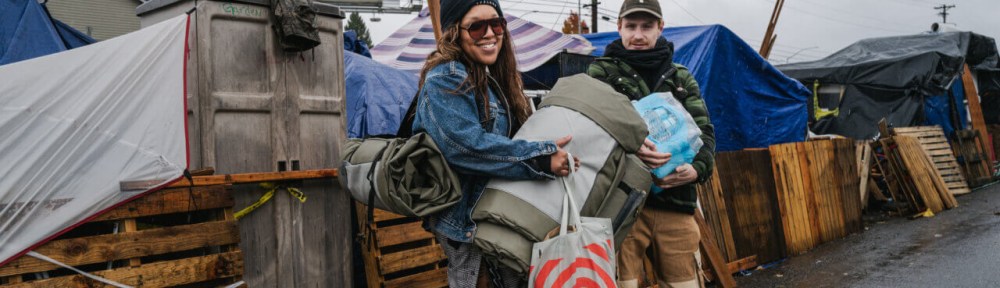
In the winter of 2023, Sheltersuit handed out 750 Shelterbags in the US Pacific NorthWest in partnership with Greater Good Northwest, Rose Haven, and Transition Projects. These suits came all the way from the social factory in South Africa where they were produced. “I really believe in the work Sheltersuit is doing, employing people who otherwise might not have a chance to access these opportunities,” says Eboni Brown, director of Greater Good Northwest in Portland, who first contacted Sheltersuit in 2019. “I believe in Bas’ mission and I understand where he’s coming from.”
Sheltersuit is producing a magazine, Unsheltered Moments, to help people understand the stories of people who are living unhoused.
Sources:
Sheltersuit website.
This jacket is actually a portable shelter for homeless people Mashable, Feb. 28, 2020
Design Indaba Showcases A Wealth Of Visionary Projects On Its 25th Anniversary Forbes, Feb. 28, 2020
In the winter of 2023, Sheltersuit handed out 750 Shelterbags in the US Pacific NorthWest in partnership with Greater Good Northwest, Rose Haven, and Transition Projects. These suits came all the way from the social factory in South Africa where they were produced.
“I really believe in the work Sheltersuit is doing, employing people who otherwise might not have a chance to access these opportunities,” says Eboni Brown, director of Greater Good Northwest in Portland, who first contacted Sheltersuit in 2019. “I believe in Bas’ mission and I understand where he’s coming from. I’ve lost a lot of people on the streets, so his message really speaks to me.”
Sources:
Sheltersuit website.
This jacket is actually a portable shelter for homeless people Mashable, Feb. 28, 2020
Design Indaba Showcases A Wealth Of Visionary Projects On Its 25th Anniversary Forbes, Feb. 28, 2020
Cover image: Some of the people who received Shelterbags in Portland, Oregon, in 2023. The bags were made in Sheltersuit’s social factory in South Africa.
 Hopebuilding