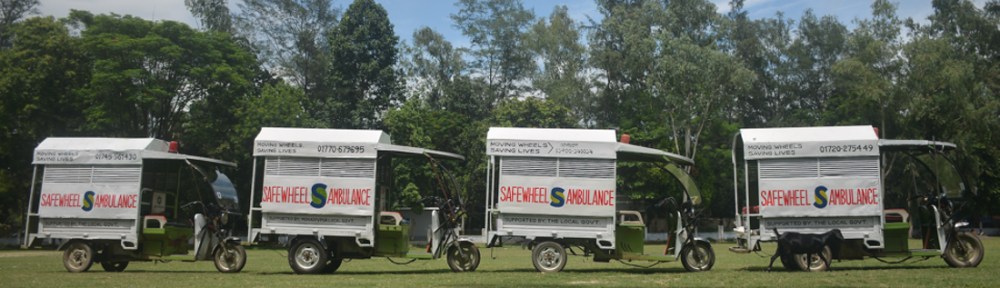
Rickshaw ambulances are providing access to emergency health care in rural Bangladesh during medical emergencies, thanks to a brilliant and award-winning practical solution developed by three young friends.
It was a personal tragedy in 2016 that led the men to design three-wheeler rickshaw ambulances – a solution that could work in other countries such as India, Indonesia, Nigeria, Mexico, and Philippines, where villagers in rural areas have similar challenges.
Co-founder Faysal Islam was chosen as the 2021 Commonwealth Young Person of the Year, and the Regional Youth Award winner for Asia, for his work on the project, and Safewheel was awarded nearly USD $7,000 in prize money. He explained the work of Safewheel to the Duke and Duchess of Cambridge in a video interview.

In 2016, Faysal’s friend Rafiq Islam (not related) lost his uncle because no ambulance was available to help him after he had a motorcycle accident while on his way to help a friend. Rafiq’s father called a rickshaw to take his brother to hospital, but he died before they got there.
An ambulance – with equipment, a medic, and first aid – would have saved his uncle’s life, Rafiq says. But it was their travels across Bangladesh that led them to realize the magnitude of the problem in poor rural communities.
About 1,200 ambulances serve about 105 million people who live in 68,000 villages – about one ambulance for 88,000 people. But only 7% of the vehicles have a paramedic and many are in serious need of an upgrade. Apart from taking hours to reach a patient, conventional ambulances charge patients more than they can afford, don’t have proper medical equipment and don’t have paramedics on board. Often the drivers have trouble finding a patient’s location.
Safewheel planned to create three-wheeler ambulances that were affordable, always available, and small enough to navigate narrow rural roads. Its low-cost three-wheeler ambulances cost 1/10th of the cost of a conventional ambulance. Each has the necessary basic medical equipment to save lives, and its real-time vehicle tracking system allows us to monitor the effectiveness and efficiency of the system.
Safewheel’s Hult Prize application was supported by a municipal government that allowed them to create 10 three-wheel ambulances that served over 1,000 patients, in more than 150 villages, for four months. The idea won the regional round of the Hult Prize, which is the world’s largest student entrepreneurship program, and led to a pilot project.
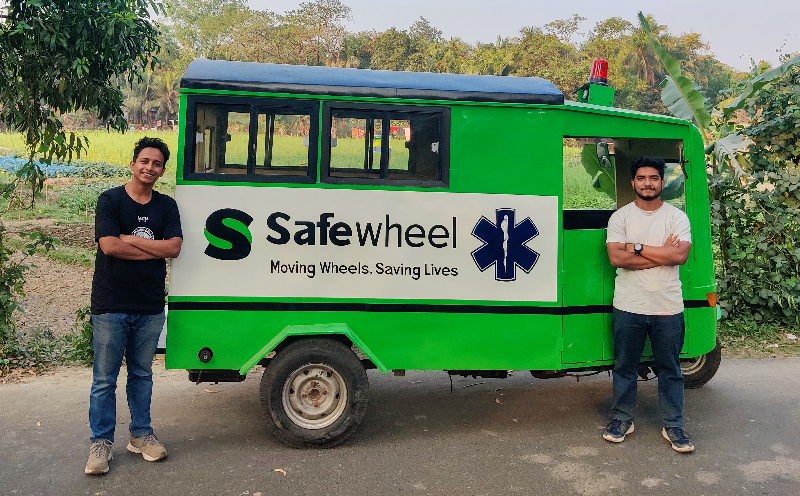
To take the idea beyond the pilot stage, Faysal, Rafiq, and their third co-founder Anas Makki, entered the Youth Co:Lab National Dialogue, in Bangladesh.
Youth Co:Lab, co-led by UNDP and Citi Foundation, focuses on helping young social entrepreneurs achieve their dreams. Winners of the National Dialogue are accepted into the Springboard Programme, an incubator that provides startups with support, tools, and mentorship, and the team says that has played a critical role in taking Safewheel to the next level. “While we worked hard, the support from Springboard has provided us with the essential tools and advice to make Safewheel a success.”
Springboard has nominated and mentored Safewheel for several competitions including: the first APYE Online & Global Social Innovation Idea Competition where they were the first runner-up; the Startup Impact Summit, Hong Kong; and their application for Forbes 30 under 30.
They also recently signed an agreement for US $100,000 with the Impact Matching Fund Biniyog Briddhi – a financial support scheme by the Embassy of Switzerland in Bangladesh, financial advisory firm Roots of Impact, and business consulting firm LightCastle Partners.
While Safewheel’s response time is already the shortest in rural Bangladesh, it is working on ways to make it even faster, including a smartphone app that would allow a patient to find the nearest Safewheel ambulance. Its 10 tech-enabled ambulances can send live updates to the hospital about patients’ condition, reducing the waiting time in emergency treatment and helping save the lives of critical patients.
As well as regular ambulances for emergency patients, Safewheel offers a doorstep medical service that provides in-home treatment to people with minor injuries who do not require a hospital visit. In both cases, the cost is half of the available ambulances in the market.
Sources
Young leaders from Bangladesh, Grenada, Samoa, Sierra Leone and UK win 2021 Commonwealth Youth Awards The Commonwealth, Mar. 10, 2021
An Incident that Led to an Idea and a Springboard to Success UNDP, Mar. 26, 2021
Design Indaba Showcases A Wealth Of Visionary Projects On Its 25th Anniversary. Forbes, Feb. 28, 2020
Elevate Prize entries. MIT.
20 finalists announced for Commonwealth Youth Awards 2021 The Commonwealth, Jan. 27 2021
Cover image and other photos: Safewheel
 Hopebuilding