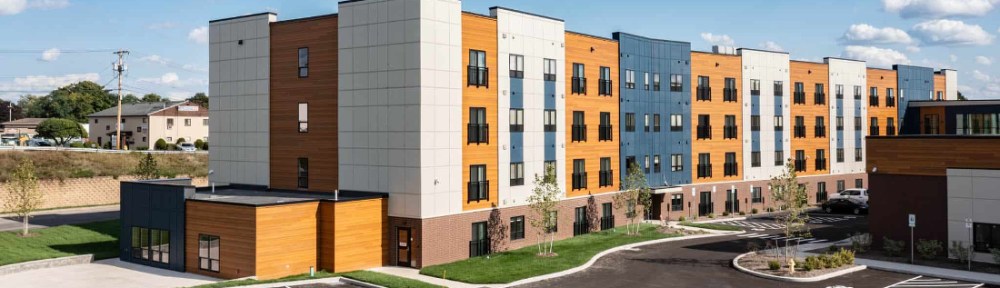
In a small town in upstate New York, the Skyview Park seniors residence sits where the Sears store used to anchor the Irondequoit mall. The store was retrofitted into 73 rental apartments that are connected by a raised pedestrian walkway to a new four-story multi family building with 84 rental units built on the adjacent parking lot.
There are three open-air courtyards, community gardening space and two patios with grilling areas. Residents can access senior programming at the Irondequoit Community Center, a 40,000-square-foot community centre built at the site, via the former Sears building.
“As developers, we try to address housing affordability, neighborhood blight, community growth, and sustainability,” says Amy Casciani, who co-led the Skyview Park development. “Sometimes, to accomplish our goals, we need to look ‘outside the box.’ In our ever-changing economic environment, we should be willing to utilize creative, adaptive re-use as one measure to address issues in our communities,” she added.
“This is not an easy development to accomplish, but I believe it’s a necessary one to accomplish,” she told Vox. “I think it can make an even bigger impact on communities than new construction.”
There are other examples of partial or full conversion of old shopping malls. In Atlanta, Georgia, the 1960s-era Moreland Plaza shopping centre was bulldozed last year to make way for nearly 700 new housing units, including townhomes and multifamily apartments.
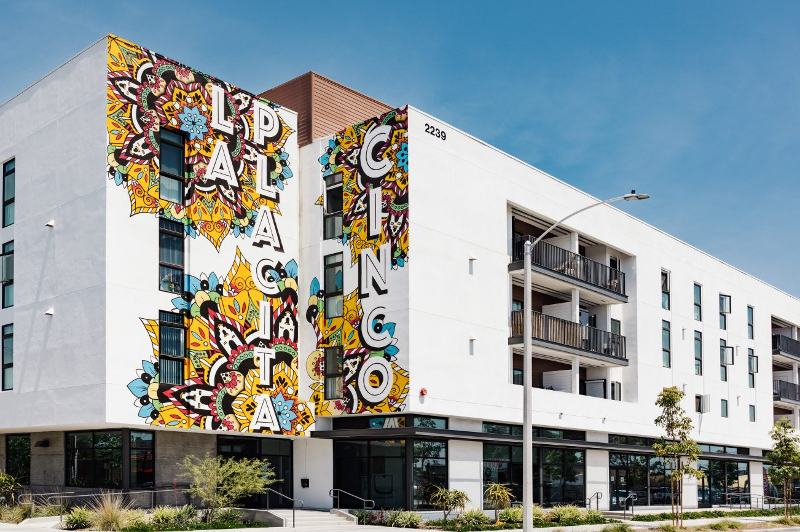
In Santa Ana, California, La Placita Cinco converted the former Tiny Tim Plaza’s gas station and part of the parking lot into a mixed-use development that includes ground-floor community space and 51 two-, three- and four-bedroom affordable rental apartments. The final redevelopment maintained the retail portion and lessees while adding the new multifamily housing.
And in a town just north of Boston, an old mall on a 23-acre plot of land has been transformed over four years into Woburn Village, with 350 rental units, amenities like a fitness centre and swimming pool, and retailers.
It is one of more than 3,000 strip malls sitting on thousands of acres of land across the Greater Boston Area, and the Metropolitan Area Planning Council (MAPC) says that if just the top 10% were converted into mixed-use development, more than 125,000 new housing units could be built.

Enterprise Community Partners, a national nonprofit agency that is focused on increasing housing supply, says that across the US, more than 700,000 new homes could be created by repurposing strip malls.
While interest grew in converting empty office buildings into housing after the pandemic and the growth of remote working, conversions can be challenging. But strip malls offer unique opportunities. Many are more than seven decades old and it costs more to maintain them than it would cost to demolish and rebuild.
They are typically built on property that includes large amounts of surface parking, which can make it easier for developers to build new projects, and many of them are located in the suburbs.
The International Council of Shopping Centers says there is 947.5 million square feet of strip mall space across the US. The 18-page Enterprise report just looked at the 10% that were best suited for conversion.
There is no one-size-fits-all strategy that is suitable for repurposing every single strip mall, as each property has its own characteristics and circumstances, says the report.
Sources:
America is full of abandoned malls. What if we turned them into housing? Vox, Apr. 10, 2024
Repurposing Underutilized Strip Malls to Create Multifamily Housing. White paper, Nov. 2023. Ahmad Abu-Khalaf, Enterprise.
Cover Image: Skyview Place development in the former Irondequoit mall in upstate New York.
 Hopebuilding
MAPC does amazing work!