
While the Maldives is a nation of about 1,200 small coral islands in the Indian Ocean, many of its residents – particularly women and girls – miss out on jobs in marine conservation and tourism because they don’t know how to swim.
Their safety also is endangered, as most Maldivians live a short distance from the ocean and must travel regularly among islands using government-operated ferries and private speedboat services. “They must be prepared for any incident that could occur during their many journeys from one island to another,” says Aminath Zoona, the first Maldivisan woman to be an accredited swim-and-snorkel instructor.
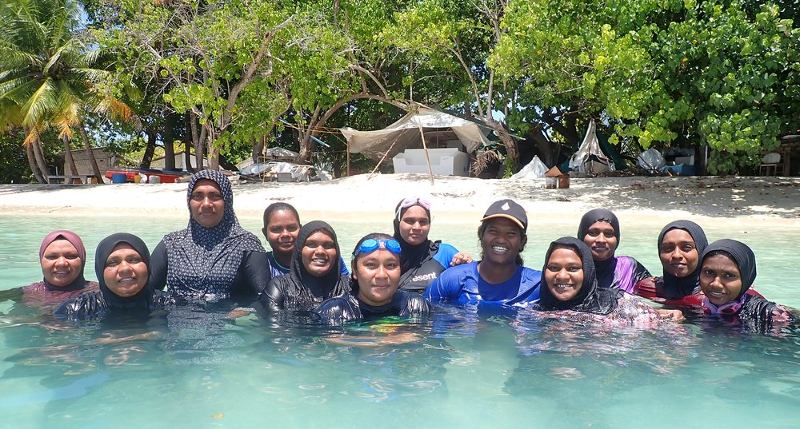
She trains women as part of the Ocean Women program pilot launched by the Manta Trust, a UK-based marine conservation nonprofit. At an early age, her father, a professional diver, took her to the beach in the nation’s capital, Malé, and taught her to swim. She eventually coached her younger siblings and cousins, and later her own three children.
The opportunity to become a certified swim instructor happened in 2016 when a swim-instructor trainer from Scuba Schools International (SSI) came to Malé to coach. After completing the swim-instructor course, she pursued certification to be a trainer of swim-and-snorkel instructors, becoming the first Maldivian woman to earn this credential.
In 2019, she founded her own business, Salted Venture Swimmers, a swimming school in Malé. Today, she has a team of 10 instructors – both female and male – who teach children from the age of two months upward, as well as adults. “Our classes are full with kids wait-listed,” she says.
In 2022, when Manta Trust announced its Ocean Women program to train local women to become swim-and-snorkel instructors, Ms. Zoona approached Flossy Barraud and offered her expertise. Ms. Barraud, who had been on the lookout for a local partner who shared the Manta Trust’s goals of marine conservation and equal access to the ocean, welcomed her interest.
Manta Trust says that in many tropical coastal communities with large ocean areas, women and girls do not swim, snorkel or engage with the ocean as much as men and boys do. Worldwide, two-thirds of women cannot swim.
But it has learned, working in more than 20 countries, that to sustainably protect the biodiversity that mobulid rays depend upon, coastal communities must develop and lead conservation initiatives that work for them. They are often biodiversity hotspots, and therefore their populations play a disproportionately large role in ocean conservation on a global scale. All over the world, indigenous knowledge prioritises nature protection. But in some communities, certain groups of people, including women and girls, do not access the ocean recreationally as much as others.
Manta’s research with Maldivian school students reveals that girls are 50% more likely than boys to have never snorkelled, and four times more likely to feel unconfident swimming in the sea.
“As Maldivians, we all should know how to swim, but that is not the reality. Most of us are scared to go to the sea and do not possess the basic skills of swimming,” says Hamda Ibrahim, Maldives’ second school marine science teacher. “As a teacher, I would say that my student’s learning is very much limited because they don’t know how to swim.”
Additionally, young people in the Maldives are often unaware that environmental careers exist or that they could pursue them.
“We are coastal people living in a large ocean state, and our very survival is dependent on a healthy marine ecosystem,” says Maldives Manta Conservation Program board director Maeesha Mohamed. “I believe that actually showing people what they have in their backyard is key to a future with environmentally conscious individuals who are passionate about protecting the ocean.”
Sources:
Ocean Women. Manta Trust website.
This instructor builds confidence among Maldivian women, in the water and out. Christian Science Monitor, May 1 2024
Cover image: The instructor trainees and project leaders, November 2023 (Manta Trust photo)
 Hopebuilding