Oakland’s busy port, truck traffic, and manufacturing facilities mean that Alameda County, where Oakland is located, has some of the worst air pollution in the US. and it greatly affects the city’s low-income families.
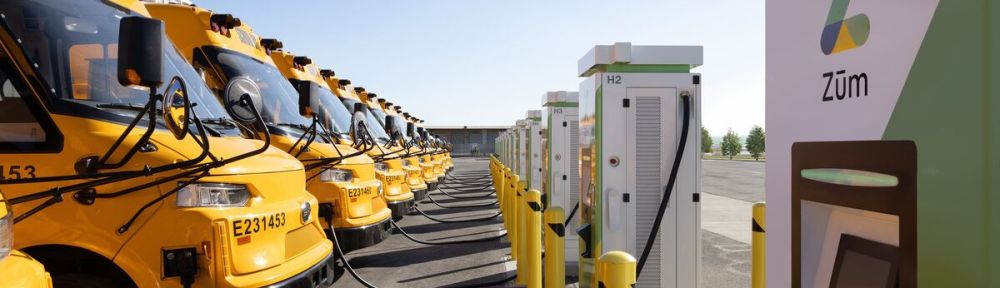
Now, wedged between a 10-lane freeway and a freight terminal, is a part of the solution – 74 electric school buses, the first all-electric bus fleet to serve a major US school district, which will supply the Bay Area power grid with enough renewable energy to power 300 to 400 homes while making the environment healthier, especially for children.
The buses will reduce carbon dioxide emissions by about 25,000 tons annually in Oakland. Its previous bus fleet ran on diesel, and the results were noticeable. “I would wipe my fingers along the inside of the bus at the end of the day and they would be black from diesel smoke,” says Marjorie Urbina, who has driven school buses for 23 years. “If it’s in the bus, it’s in my lungs.”
Most of the 480,000 school buses in the US run on diesel fuel, and low-income students account for 60% of the 20 million children they transport daily, reports Bloomberg. So electrifying school buses can play an important role in making the air healthier for all, says Harold Wimmer, chief executive officer of the American Lung Association. In Oakland, 72% of public school students come from low-income families
Zūm, a Silicon Valley startup, provides and manages the Oakland fleet, as well as those in Chicago, Dallas, Los Angeles, Seattle and other US cities. About 10% of its 3,000 buses are now zero-emission, and it aims to have its entire on-road fleet electric by 2027. It has been offsetting CO2 emissions for its entire fleet since 2021.
“Electric school buses are a unique fleet as they’re essentially large batteries on wheels that drive very few, predictable miles and can support the grid,” says Vivek Garg, Zūm’s co-founder and chief operating officer.

For the second year in a row, Zūm has been named to the 2024 CNBC Disruptor 50, an annual list that honours 50 game-changing private companies using breakthrough technology to transform industries. “I founded Zum to fix student transportation and ensure working families didn’t have to choose between work and caring for their children,” said founder and CEO Rita Narayan. “Today, Zum is proud to be ushering in a new era of increased safety, reliability, and sustainability for families across the country.”
When the new school year begins in August, Urbina and other Zūm drivers will leave the depot in the morning with 110 miles of range, ready to pick up students and take them to school. Back in the depot in mid-morning with batteries at 68% capacity, the drivers will plug the buses into bidirectional chargers designed by Zūm, taking advantage of lower electricity rates.
The buses head out again around 1:30 p.m. to take students home from school and are back in the yard by 5:30 p.m., when renewable energy production falls off and electricity demand and rates start to peak. This time, when the buses plug back into the chargers, they send green electricity to the grid at a time of day when utilities typically rely on fossil fuel power plants. When demand and rates fall after 9 p.m., the buses begin charging so they’re ready to roll the next morning.
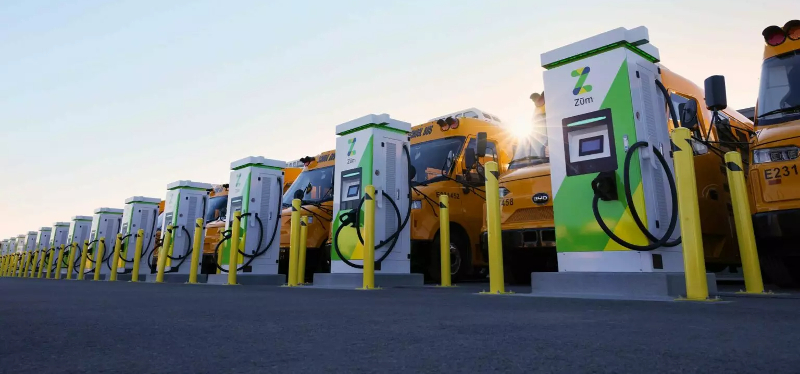
The 74 electric school buses and 74 bidirectional DC chargers will eliminate 25,000 metric tons of greenhouse gas emissions, will return more than two GWh of energy to the grid per year, will power one million homes for three to four hours, and will transport 1,300 special needs students each day.
A new study says that replacing diesel school buses with electric school buses may yield $247,600 in climate and health benefits per bus. Researchers at Harvard T.H. Chan School of Public Health found that these benefits include fewer greenhouse gas emissions and reduced rates of adult mortality and childhood asthma.
The study, “Adopting electric school buses in the United States: health and climate benefits,” was published in the Proceedings of the National Academy of Sciences, is the first to specifically quantify how electric school buses can improve human and planetary health.
“Our findings can inform policymakers that greenhouse gas emissions and air pollution are reduced by implementing solutions like electric vehicle use,” said senior author Kari Nadeau, John Rock Professor of Climate and Population Studies and chair of the Department of Environmental Health. “Our data offer strong evidence that accelerating the ongoing transition to electric school buses will benefit individual, public, and planetary health.”
Replacing an average diesel school bus with an electric one resulted in $84,200 in total benefits per individual bus in 2017, the study found. Each electric bus emitted 181 fewer metric tons of carbon dioxide than its diesel counterpart, amounting to $40,400 worth of climate benefits. Meanwhile, each electric school bus was associated with $43,800 in health savings, from less air pollution and reduced rates of mortality and childhood asthma.
In a large city, replacing a 2005 diesel school bus with an electric bus would achieve $207,200 in health benefits per bus, the researchers calculated. “In a dense urban setting where old diesel buses still comprise most school bus fleets, the savings incurred from electrifying these buses outweigh the costs of replacement,” Nadeau said.
Sources:
The First Electric School Bus Fleet in the US Will Also Power Homes Bloomberg, May 16 2024
Electric school buses may yield significant health and climate benefits, cost savings Tech Xplore, May 20 2024
Zum Transforms the Ride to School Zum
Oakland Unified School District EV Partnership. Zum
Images are from the Zum website
 Hopebuilding