
Australia’s first Indigenous-owned solar farm connected to a power grid has been officially opened in a remote community in the Northern Territory, 700 kilometres south of Darwin, offering a blueprint for how to roll-out community-owned solar across the NT’s other 72 remote communities while keeping power and profit in local hands.
The 60-member Marlinja community built the solar farm and battery after years of planning the microgrid project with Indigenous clean energy organisation Original Power. This has made it almost self-sufficient, and is expected to reduce residents’ power costs by 70%.
The solar-powered community centre is the first step, offering a hub for kids, family and cultural activities. It’s part of a much larger plan for the community to go 100% renewable and generate its own electricity from solar power with battery storage.
/
“Solar powering the Territory’s remote communities makes so much sense, and community-ownership models like that being advanced at Marlinja are the best way to ensure that the benefits of cheaper, cleaner energy are delivered directly back to local families and businesses,” said Original Power Executive Director Karrina Nolan.
Community members are engaged in project planning, installation of rooftop solar panels, and training in electrical technology and carpentry skills. Marlinja school students also took part in a Solar Schools Day to learn more about how solar power works for the community.
“For years now our region has featured in the development plans of big companies, whether it be gas fracking, mining and more recently even big solar farms. But these projects offer next to no local benefit, and plenty of risk to our land, water and cultural heritage,” said Mudburra community leader Raymond Dixon. He has helped guide the project to completion.
“We see community-owned solar power as a way to meet the needs of local families and businesses, keeping power and any profit in local hands so we can reinvest that into our future and start making positive changes in our people’s lives,” he said.
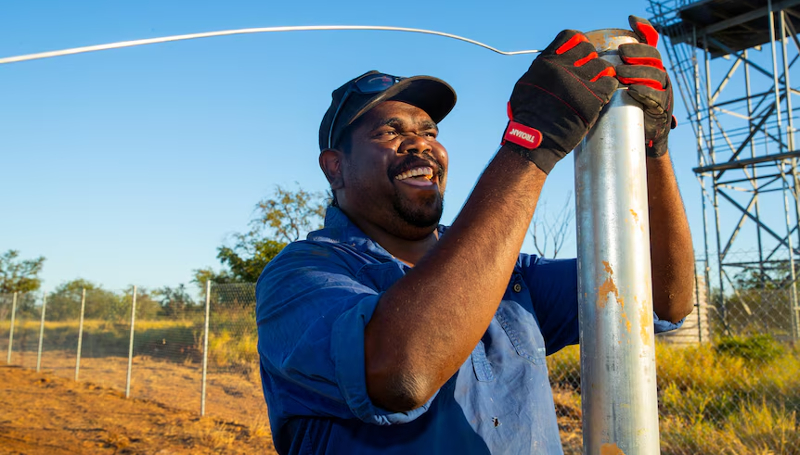
“I was putting $100 a week, and some of my family were putting in $50 or $20 that would only last them half a day, or just a few hours, it was crazy,” he said. “It will take the pressure away from families, every household in Marlinja.”
“We’d like to see more support from the Northern Territory government to help our communities go all the way with solar power. Not only will it help locals but we’re helping the government meet its economic recovery plans, their Renewable Energy Target and Climate Action plans too so it’s really a win-win for the whole Territory and our shared future.”
Marlinja resident Janey Dixon said the community had suffered wet season disconnections from their nearest diesel power station at Elliott, 25 kilometres away, for years. “When you have electricity generated by fuel, it goes off, and we have to wait for them to come across with the boat to fix it, and it takes two or three days,” she said.
As well as having more reliable local electricity, the microgrid meant residents wouldn’t have to buy as many expensive power cards to run their household meters, she said.
“We are really proud [of] what we have here at the community; we’ve got solar going in our community now without any money to pay, it’s free in the household,” she said.
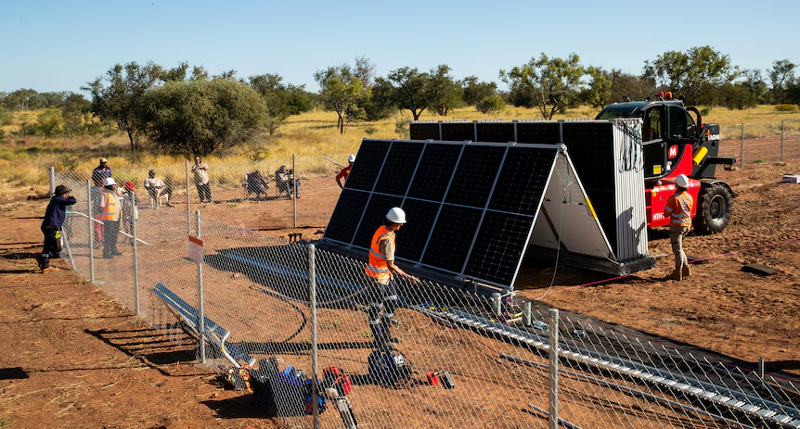
Original Power clean energy communities coordinator Lauren Mellor helped the Marlinja community raise $750,000 from benefactors to pay for the infrastructure.
“Any excess electricity will be used to charge the community battery, and will mean that the residents can access that for night-time use,” she said. “When the battery runs out, then residents will flip back onto the grid, so residents will be saving at least 70%on their power bills.”
Mellor helped Marlinja negotiate with the NT government – which owns all of the NT’s electricity system – for permission to connect to its grid. “It means that the government-owned power corporation will be saving on avoided diesel generation costs from the Elliott power station, so it’s a win-win for both it and the community,” she said.
But while being connected to the grid means that Marlinja can draw power when it needs extra, the community is not yet allowed by the government to sell power into it.
The roadblock is similar to the one that has stopped four NT commercial solar farms, completed four years ago, from starting to supply renewable power.
NT Chief Minister Eva Lawler said commercial and community solar farms could not start supplying the NT grid until there was enough battery storage in the system to stop intermittent solar power causing blackouts.
But with some batteries now under construction, she hopes connections would happen soon.
“The issue has been around the stability of the grid, so that has been a sticking point, but we are getting very close to full implementation of those solar farms,” she said. “We want to facilitate renewable energy. We want to get to our 50% by 2030 target.”
Ms Dixon said she was delighted her community had become one tiny part of the transition.
“We are so happy inside of our stomach and inside of our heart, and we’re so proud that we’ve got clean energy from the sun, that’s in our community, right now,” she said.
This is what they imagine things will be like in 2030….
“With the power of the sun harnessed on Country, Marlinja’s community power project led the First Nations clean energy transition. The simple, low-cost solution fast tracked the switch from diesel, providing security in a warming climate whilst unlocking new, culturally-aligned economic opportunities. The reliability of supply expanded capacity to uphold cultural responsibilities, and introduced new low carbon training pathways on Country. A research and development breakthrough in 2027 allowed the incorporation of feed-in tariffs, further supporting Indigenous autonomy as communities supplied energy to their own industrial and agricultural ventures. The NT Govt’s savings from diesel subsidies – over $30 million annually – were redirected to the expansion of Caring for Country programs, further validating the participatory essential services model.”
Sources:
How every resident in the remote community of Marlinja has reduced their power bill by 70 per cent ABC News, June 6 2024
Marlinja Community Power Project. Innovate to Regenerate.
Marlinja Community Power Project. Original Power
Photos by Rachel Mounsley
 Hopebuilding
Love the 2030 vision! May it be so!!