
In 2011, when drought loomed across much of England, Andrey Ivanov faced a tough decision about Wilkin & Sons signature strawberry and raspberry crops.
“I remember the year 2011-2012, when our reservoirs were only half full, and we only had enough water to irrigate until mid-May, maybe end of May,” said the general manager. “We had to make a tough decision – to irrigate only 20% to 30% of the crop or risk losing everything and hoping for rain. But then, on the 12th of April, the heavens opened, and we had the wettest summer on record.
“That experience taught us a valuable lesson, and we put together a plan to extend our capacity to avoid facing these challenges again. We’ve got the water, we’ve got the opportunity, and we need to do more. Now, we can say we are fully resilient in terms of water.”
Located in a dry area of Essex, the region received only 515 millimeters of rain in 2022, comparable with some of the world’s driest countries. So the 650-acre farm has been proactively managing water for years.
In the 1980s, they introduced rainwater harvesting on a small scale, diverting rainwater from the farm’s gutters into new reservoirs. Now the entire factory, yard, and growing tunnels have been fitted with a drainage system that captures rainwater and diverts it to the reservoirs for irrigation later in the season.
Now all seven reservoirs are full, so the farm can supply all of its own water for the first time. Its water storage capacity (now 60,000 cubic meters) will be doubled when a new reservoir is finished, with a capacity of up to 62,000 cubic meters when full.
“It’s a much more comfortable position to be in, to not worry about whether we will have enough water this year, and where we’re going to find it, if we end up in a drought again.”
“If farmers around the country haven’t started rainwater harvesting already, they will be doing it now,” says Ivanov.
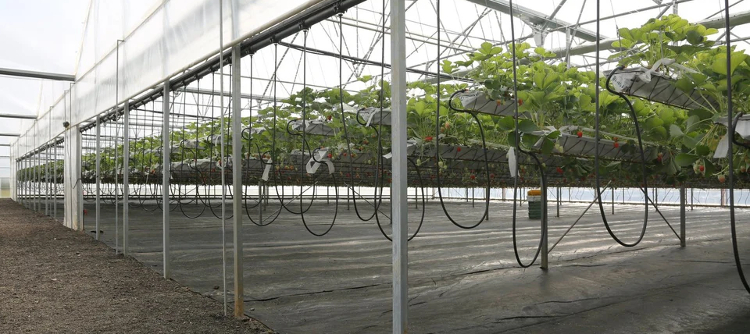
He’s working on making Wilkin & Sons even more sustainable and resilient. He recently applied for planning permission to install 25 acres of solar panels to help reduce the farm’s energy costs. He is also experimenting with drought-resistant berry varieties, and adjusting water levels to find the minimum levels the plants need.
“We need to adapt and develop flexible strategies that can withstand climate impacts, by anticipating various climate scenarios and adjusting our business plans accordingly,” he says.
“We’re extending the typical two-to-three-year decision horizon to 10, 20, or even 50 years and recognizing that climate impacts may not be immediately visible, but will accumulate over time.”
Tiptree Farms is a family-run business that started as an arable farm 300 years ago and transitioned to fruit production 150 years ago, which was so successful they began selling excess as preserves. In 1885, the farm began producing its own jams, which later became the flagship product under the ‘Wilkin and Sons’ brand.
Today, the jam business is the biggest side of the business, and Tiptree also operates tea rooms throughout Essex, a patisserie and a pudding business.
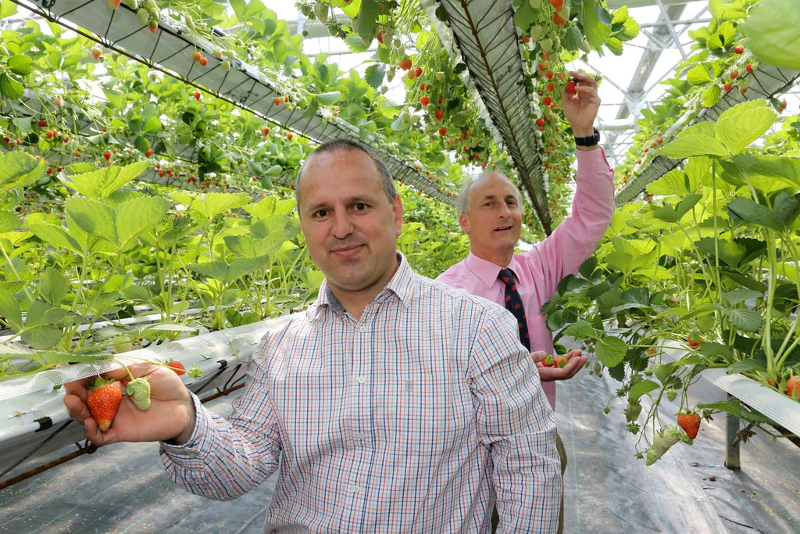
Beyond conserving water resources, TIptree Farms’ rainwater harvesting also helps reduce flooding and stormwater runoff in the surrounding area. Tiptree farms to LEAF (Linking the Environment and Farming) standards. Underground micro-irrigation systems ensure water isn’t wasted (in some fields that means that each plant is drip-fed water, controlled by Andrey via his smartphone). Pipes and energy cables run under the fields and reservoirs recycle water used for jam-making and rainwater for use during the drier months.
Picking the berries provides an income for the seasonal international workers who have come to the farm each year since the 1950s, says Reasons to be Cheerful. This year, 250 workers from countries including Bulgaria, Romania, Serbia, North Macedonia, Moldova, Ukraine, Uzbekistan, Kyrgyzstan and South Africa are staying in mobile homes on the property where they have access to cooking and laundry facilities, Wi-Fi, plus a hall to socialize in, for a weekly fee of £69 ($88 US) that is capped by the UK government.
“I would love to staff our operation with local people, but we can’t offer full-time employment all year-round, so our international workers are really important,” says Ivanov. Wilkin & Sons established its work camp in the 1950s, when the UK government’s agricultural work scheme incentivized international students. The scheme, ended in 2014, was relaunched two years ago and extended to all ages. The average age is now around 40, and roughly 75% of workers tend to return season after season.
“We never advertise. Our motto is to look after the workers and they’ll come themselves. The whole industry is competing for the same people. If we can offer better conditions than our neighbors, they’ll come and stay with us,” says Ivanov.
Tiptree invites others to enjoy the countryside. Public footpaths criss-cross the fields and one of the farm tracks is open to visitors with signs to explain what’s happening and what to look out for. All Tiptree asks is that visitors respect the countryside and keep off the crops.
Sources:
How an Iconic Jam Maker Got Smart About Water Use. Reasons to be Cheerful, Jun. 27 2024
Water management strategies in England’s driest county. National Farmers’ Union, Apr. 25 2023
 Hopebuilding