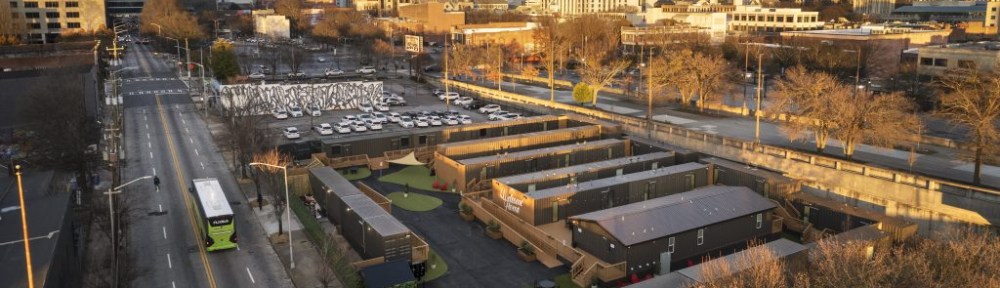
In four months, a nondescript city parking lot became the City of Atlanta’s first Rapid Housing project. The 40-unit multifamily community is part of Mayor Andre Dickens’s plan to create 500 housing units for the city’s homeless by 2025.
The gated micro community known as “The Melody” no longer looks like a parking lot. Artificial turf is spread across the asphalt. There are potted plants and red Adirondack chairs, and even a dog park. It is the fastest fully permanent multifamily project in the city’s history.
“The Melody was actually named after one of our participants,” said Leni Garner, care navigator supervisor for the Policing Alternatives & Diversion Initiative. “Her name was Melody [Bloodworth] and she passed away on the corner across the street from a fentanyl overdose. And one of our people that went to work on that project asked they name it after her, kind of as dedication, but also because if she had housing like The Melody, maybe she wouldn’t have died on the street.”
The shipping containers have been turned into 40 insulated studio apartments that include a single bed, HVAC unit, desk, microwave, small refrigerator, TV, sink and bathroom. The community includes a communal garden, dog park, and gathering spaces including a community area equipped with a kitchenette, offices, and laundry facilities. Residents moved in on February 6th.
Giving each resident their own bathroom and kitchen helps set The Melody apart, said Cathryn Vassell, whose nonprofit, Partners For Home, oversees the micro community. Aside from a prohibition on overnight guests, staff emphasize the tenants are treated as independent residents.
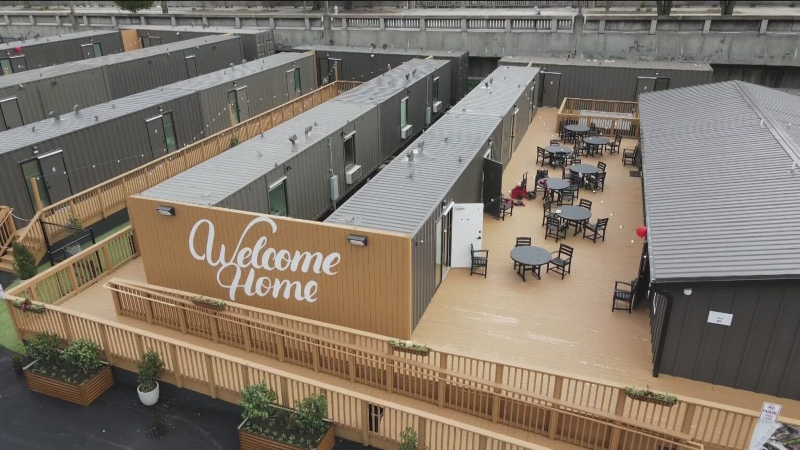
Vassell acknowledged it’s unclear how long the containers will last — she’s hoping 20 years. But, she said, they were the right choice for The Melody because they were relatively inexpensive and already had handicap-accessible bathrooms as many were used by Georgia hospitals during the COVID-19 pandemic.
The project cost about $125,000 per unit — less than traditional construction, and much quicker. Staffing and security operations cost about $900,000 a year.
“I’m just so grateful,” said Cynthia Diamond, a 61-year-old former line cook who uses a wheelchair and used to be chronically homeless. “I have my own door key. I ain’t got to worry about nobody knocking on my door, telling me when to eat, sleep or do anything. I’m going to stay here as long as the Lord allows me to stay here.”
Residents at The Melody are connected to a dedicated housing case manager who can help them chart their own path to stability. The team includes two fully licensed clinicians and two peer support specialists. Additionally, there is an on-site resident assistant, somebody who has lived experience with homelessness and who will provide additional support for tenants and facilitate a residents council.
US city officials have been turning to such micro communities that are small, quick, and cheap and, combined with wraparound services, offer stability that helps residents move towards secure housing.
Denver has opened three micro communities and converted another five hotels for people who used to be homeless. It built three communities with nearly 160 units total in about six months, at roughly $25,000 per unit. The 1,000 converted hotel units cost about $100,000 each.
On site at the micro community are bathrooms, showers, washing machines, small dog parks and kitchens, though the Salvation Army delivers meals. More than 1,500 people have been moved indoors through the program, with over 80% still in the housing as of last month.
“Housing is a ladder. You start with the very first rung. Folks that are literally sleeping on the ground aren’t even on the first rung,” said Denver Mayor Mike Johnston.
Both Atlanta’s and Denver’s programs act as a stepping stone as they work to get people jobs and more permanent housing, with Denver aiming to move people out within six months.
They offer residents case management, counseling, mental health and substance abuse therapy, housing guidance and assistance obtaining anything from vocational skills training to a new pair of dentures.
“We’re able to meet every level of the hierarchy of needs — from security and shelter, all the way up to self-actualization and the sense of community,” said Peter Cumiskey, the Atlanta site clinician.
Sources:
Micro communities for the homeless sprout in US cities eager for small, quick and cheap solutions. Associated Press, Jun 14 2024
Quick Facts: The Melody Project Partners for Home
The Melody: A Blueprint For Rapid Housing. Beck, Feb. 14 2024
Christened ‘The Melody,’ homeless housing initiative opens today Atlanta Urbanize, Jan. 26 2024
The Melody Housing Development BMarko Structures
Atlanta opens first rapid housing project to address homelessness The Southerner, Mar 11 2024
Cover image; Beck Group
 Hopebuilding