
Seth Long, who leads a non profit that builds homes in Appalachia, wasn’t always a believer in the value of solar but he had long been looking for relief from high electricity bills. Despite adding energy efficiency measures to the office, the bills from Kentucky Power were still as high as $1,600 a month, something that wasn’t sustainable.
Then Josh Bills, an energy specialist from the economic development organization Mountain Association, showed him that HOMES Inc. could benefit financially from installing rooftop solar on its office in Whitesburg, even if it borrowed the entire cost of the solar system.
“In our climate today, everything gets political,” said Long, executive director of HOMES Inc. “This doesn’t have to be about left or right. This doesn’t have to be about coal or solar. It can be about common sense, too. As coal built this country with energy in the past, we need to pivot. And I think solar can play a part in that pivoting to something else.”
The system performed even better than the projections. “We came out ahead financially, way ahead,” Long said. “Some of our electric bills since then have been as low as $53 a month. It was eye opening to me.”
He added solar to his maple syrup farm to save money there. There was funding to help small businesses in Eastern Kentucky become more efficient but there were fewer resources for installing solar on affordable housing. That changed following the terrible 2022 floods, and HOMES Inc. has been able to help homeowners rebuild in energy efficient ways.
A 2023 report said Kentucky Power’s residential customers paid the highest average monthly bill in the state at $187.56, and it is the poorest Kentucky ratepayers whose bills can reach more than $400 a month due to poor insulation and energy inefficient electric heating.
In Whitesburg, water reached about 21 feet before the gauge failed by which time the previous record (set in 1957) had already been surpassed. Further north, the North Fork of the Kentucky River overflowed and floodwaters crested at 43.47 feet, surpassing the 1939 record. Flash flooding from what are called “training thunderstorms” caused most of the damage.
“The flood has given us opportunities to tear down older homes and replace them with new energy efficient homes and even ‘net zero’ houses,” says Long.
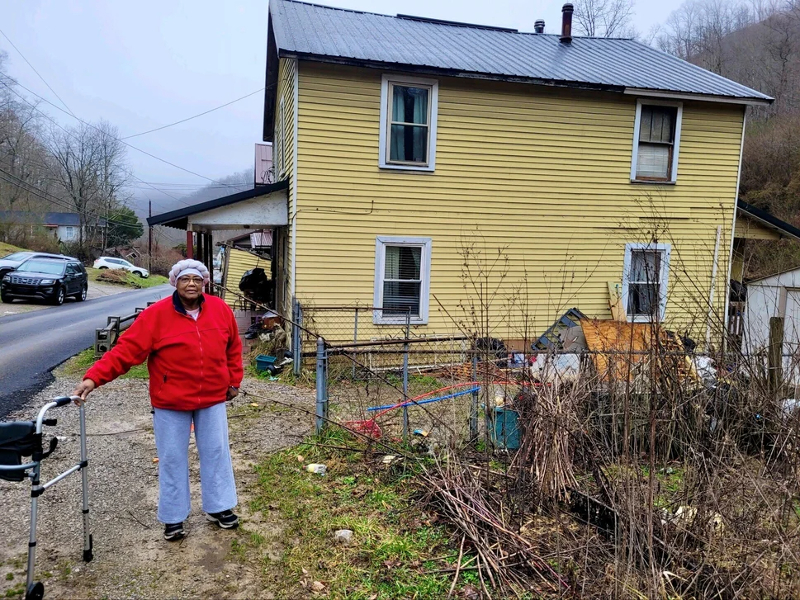
One of the houses damaged by the floods belonged to Lois Thompson, 76. Her coal camp house was built over 100 years ago, and constructed without a permanent foundation. The house sagged and the frame ballooned. The second floor was unsafe.
The utility bills were high, but the house was cold all winter. She had a heat pump but couldn’t afford to run it on her fixed income, so she would hang up an old quilt to section off part of the main room that she heated with a propane heater. “For the people like me that don’t have the money, you’re living in a drafty house. … You can’t insulate it. You don’t have the money for that.”
Water from a nearby stream had destroyed the heat pump and soaked through the floorboards. This time, when Lois called HOMES, Seth saw a chance for a major upgrade instead of just minor improvements. Using relief money from FEMA along with support from HOMES, Lois could afford to have her old house replaced with a brand-new, accessible two-bedroom, one-bathroom home with a rooftop solar system that will provide 100% of her energy needs, on the same lot. She moved into the new house in August.
“It still don’t seem real, and I’m living in it,” she said. “I say, ‘Lord, I thank you.’ That’s all I can do.” Her new home has a negative 17 on the HERS index, which compares a home’s energy efficiency to a home built by average standards. Thompson’s “net zero” home generates more electricity than it uses. Her electricity bill in October was just $21.61, slightly more than the minimum charge for utility customers in her community.
HOMES Inc. is now working on a new housing development for flood survivors that will have eight “net zero” homes – houses with zero monthly electrical costs because of energy-efficient construction and rooftop solar panels that generate power. HOMES also works with businesses to install solar panels on commercial properties, including Housing Development Alliance in Hazard and Middlesboro Community Center, whose solar system will save the city of Middlesboro $8,500 per year.
In a region built on coal, soaring utility bills and the need for housing means the energy future could be driven by the power of the sun.
Sources:
Eastern Kentucky housing builder looks to the sun for relief from crushing power bills Kentucky Lantern, Oct. 31 2024
‘A new home offers hope again’: Organization begins build for family home lost to flood, fire Mountain News, Dec. 18, 2023
Housing Development Alliance and HOMES, Inc. Helping to Rebuild After Flooding Kentucky Housing Corporation
Net-Zero Houses in Letcher County Kentucky Housing Corporation, Apr 22 2024
Cover image: Lois Thompson says her new house’s porch is “out of this world.” She moved into the “net zero” home in late August. (Kentucky Lantern photo by Liam Niemeyer). The other picture is of her old house, from the Kentucky Housing Corporation.
 Hopebuilding