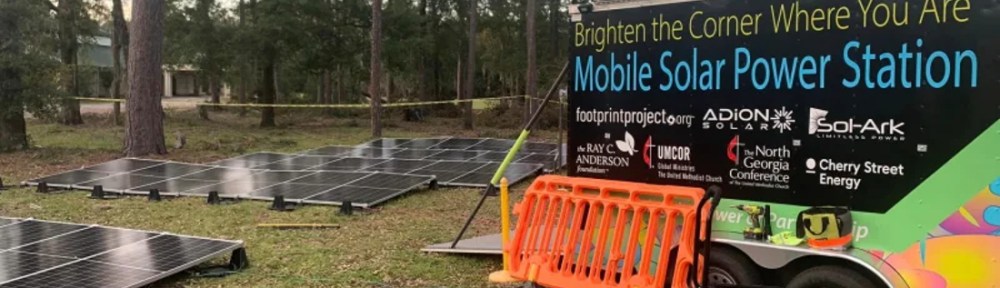
A solar disaster response trailer built in Georgia for use in that state is now deployed to support local disaster recovery efforts, says the Ray C. Anderson Foundation. The Mobile Solar Power Station was unveiled at the annual Ray Day sustainability celebration last year; nearly a year later, it was deployed to help Georgians for just this kind of scenario.
The state of the art solar microgrid is powering lights, large freezers, and refrigerators at Camp Tygart, run by the North Georgia Conference of The United Methodist Church. The trailer has allowed other generators to be used to power a pump for the well, allowing four toilets to be functional, and now volunteers can take showers, and have access to air conditioning.
The early response team volunteers that are based at Camp Tygart are spending their days in the surrounding communities, aiding victims with clearing trees and other debris, providing food, water and medicine, assisting at shelters, and managing communication hubs that allow victims to reach out to their families.
The disaster response trailer combines environmental sustainability with the organization’s disaster ministry, a tangible example of the United Methodist Church’s commitment to creation care and environmental stewardship.
- Solar microgrid trailers, which provide clean power, are easily towed to where they are needed most during an emergency.
- They can power cell phones, refrigeration, lighting, medical devices and other critical services.
- This practical implementation of solar energy in disaster response efforts is just one way that the general agencies of the UMC are leaning into their pledge to achieve net-zero emissions by 2050 across ministries, facilities, operations and investments.
Rev. Jenny Phillips, director of environmental sustainability for Global Ministries, the humanitarian organization of the United Methodist Church, said that while disaster is never good news, she feels great that her church is able to support those in need with renewable energy.
“It adds an extra tool in the toolbelt of disaster response coordinators,” she said, acknowledging that even if they don’t completely replace traditional generators, they can complement them. “Adding solar to the toolkit also frees up other energy-generating resources.”
The solar microgrid has a total solar capacity of 16 kW, and a total battery storage capacity of 38.4 kWh. At that capacity, the trailer’s batteries could power a 325 W fridge for over 118 hours, a 1350 W heater for over 38 hours or a 1400 W microwave for over 27 hours.
“This was the first time we deployed our entire solar array,” said Tom Staigle, UMCOR Early Response Team (ERT) member and a member of Peachtree City United Methodist Church. “We had just one panel left in the trailer as a spare. The quiet, clean, renewable energy fueled the heart of the camp. It powered lighting, refrigeration, air conditioning and more.”
“It allowed for the reallocation of extremely limited fossil fuels to power a well enabling the first showers and flushing [of] toilets in five days,” Staigle said. “The solar microgrid trailer supported the volunteers putting their skills to work in a community that needed them.”
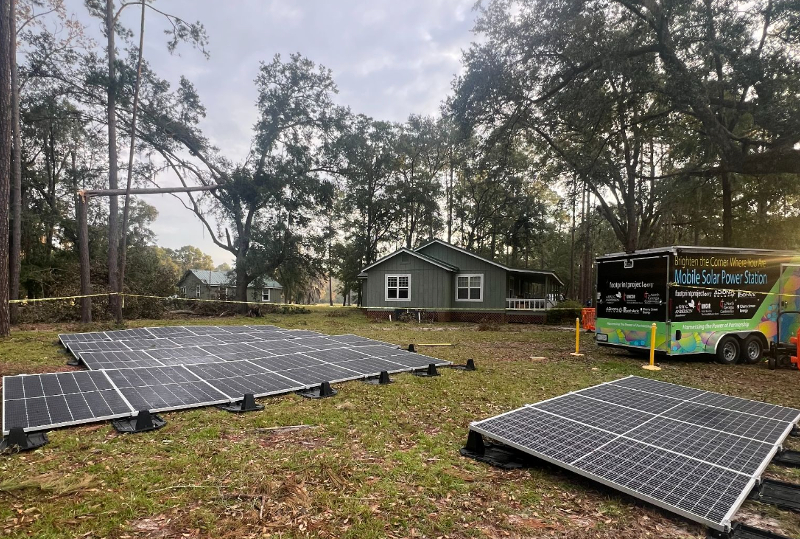
A coalition of Southeastern U.S.-based partners unveiled the solar microgrid trailer in late 2023, marking a milestone in disaster response technology in the region. The Ray C. Anderson Foundation awarded a grant to The Footprint Project to construct the trailer. Cherry Street Energy donated solar panels and technical assistance. The trailer was constructed at Adion Solar in Madison, Georgia with assistance from Sol-Ark, an energy storage company. The United Methodist Committee on Relief and the North Georgia Conference of The United Methodist Church manage, operate and deploy the trailer.
From Hurricane Ida in Louisiana to tornadoes in Kentucky and earthquakes in Puerto Rico, the Footprint Project’s microgrids have helped provide food, water, supplies, medical services, and equipment-charging capabilities to people displaced by disasters since 2018.
By providing cleaner energy for communities in crisis, Will Heegaard and Jamie Swezey are providing a template for a new, less carbon-intensive way of approaching disaster response in the US. “I think there is a mindset shift that’s happening in which people are thinking about disasters with more foresight and a longer-term lens than they ever have before, because we have to,” Swezey says.
The North Georgia Conference of The United Methodist Church used this experiment as a pilot program. Other United Methodist Church conferences like North Carolina and Florida also have similar mobile trailers. A new grant program funded by UMCOR and delivered by the Footprint Project, the Sustainable Response Technology Library, will work with United Methodist conferences that want to try the solar microgrid by giving them online training and sending the solar array to them.
“[We will] be able to provide them with some smaller scale solar devices that are easy to transport, easy to manage and set up… so that they can get a taste of what it’s like,” Phillips said. “It gives folks a chance to get their hands and different pieces of equipment to see what they’re like in action so they can better plan for their needs.” Phillips said the project will also add atmospheric water generators to their portfolio — essentially big dehumidifiers with a water filter, also to be used in crisis situations.
With climate change continuing to bring more severe and frequent storms to regions across the world, Phillips hopes that one day, they’ll be second nature in the response toolkit. “I think that’s what is so exciting about some of the technology: it’s just going to become normal,” Phillips said. “It’s a story now, it’s different now — but the dream is that we don’t put out a press release. People just say, ‘Of course they’re using solar to respond; of course they’re using atmospheric generators.’”
Photos by the Ray C. Anderson Foundation.
 Hopebuilding