I was working on a story about the new Elizabeth line in London and how it helped rebuild a wetland in Essex when I became fascinated that the tunnel boring machines were all named after women. Then I read about Vancouver’s Broadway Subway Project and learned that its two tunnelling machines were named Elsie and Phyllis. They honour pioneering British Columbians Elsie MacGill and Phyllis Munday, who were leaders in engineering and mountaineering respectively.
The tunnel boring machine which completed one of the most delicate construction segments for Montreal’s new Réseau express métropolitain (REM) 67 kilometre light rail network was dubbed “Alice” after Canadian geologist Alice Evelyn Wilson.
I discovered this is a tradition that dates back at least five centuries to Barbara, the patron saint of miners. Legend says Barbara was imprisoned by her father for converting to Christianity. After she escaped, she hid in a rocky cliff that miraculously opened to shelter her. When her father found and killed her, he was struck instantly by lightning and killed.
The Elizabeth Line
“The Elizabeth line is the first heavy rail system to pass beneath the British capital and the largest expansion of rail capacity there in 70 years,” explained the American Society of Civil Engineers. “The project included 42 km of new tunnels and 10 new stations, excavated to depths of up to 40 m below grade.”
The Tube, London subway system, was the world’s first underground railroad when it opened in 1863. Its 11 lines handle more than 1 billion passengers annually.
Considered the largest infrastructure project in Europe, the Elizabeth line covers a total distance of 100 km that features 31 existing rail stations and 10 new stations in central London.
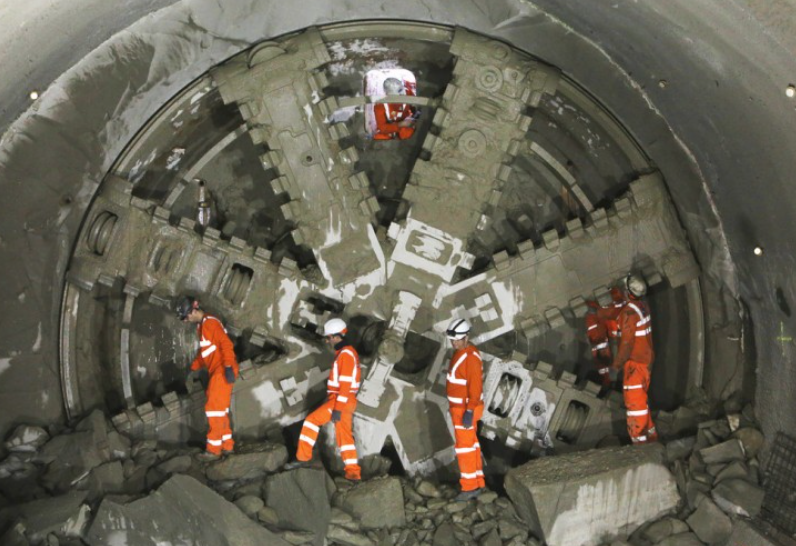
The tunnels were dug by eight tunnel boring machines — Ada, Elizabeth, Ellie, Jessica, Mary, Phyllis, Sophia, and Victoria – which weigh 1,000 metric tons each.
The Institution of Civil Engineering (ICE) says the names commemorate:
- Phyllis Pearsall, who created one of the first London A-Z maps.
- Ava Lovelace, one of the earliest computer scientists.
- Elizabeth and Victoria – honouring Queen Elizabeth II and Queen Victoria.
- Mary and Sophia – the wives of Isambard Kingdom Brunel and his father Marc Isambard Brunel, builders of the first tunnel under the Thames.
- Jessica Ennis Hill, a British heptathlete.
- Ellie Simmonds, a paralympic swimmer.
Other UK tunnels
In a fascinating article entitled She digs it: the fascinating tradition of naming tunnel boring machines after women, ICE has many other examples.
- The Silvertown Tunnel under the River Thames in East London used a TBM named after Jill Viner, who in 1974 was the first woman to drive a London bus.
- Florence and Cecilia (Chiltern Tunnel) – named after Florence Nightingale, founder of modern nursing, and Cecilia Payne-Gaposchkin, a pioneering astrophysicist.
- Anne (Birmingham) – named after Anne McLaren, a development biologist.
- Dorothy (Long Itchington Wood Tunnel) – honouring Dorothy Hodgkin, first British woman to win the Nobel Prize in Chemistry.
- Sushila and Caroline (Northolt Tunnel West) – Sushila Hirani, a local schoolteacher and lead for STEM at Greenford High School, Southall, and astronomer Caroline Herschel.
- Emily and Anne (London tunnels) – Emily Sophia Taylor, a midwife who provided maternity care for women who couldn’t afford it and was Ealing’s first female mayor. Anne’s is named for Lady Anne Byron, who established England’s first co-operative school for the working classes.
- Lydia (Atlas Road Logistics Tunnel) – Lydia Gandaa, a former teacher at a local primary school.
- Mary Ann and Elizabeth (Bromford Tunnel) – Mary Ann Evans, better known as George Eliot, the English novelist, and Dame Elizabeth Cadbury, who spent her life campaigning for the education and welfare of women in Birmingham.
- Karen and Madeleine (Euston Tunnel) – Karen Harrison, the first female train driver in the UK and Madeleine Nobbs, the former president of the Women’s Engineering Society.
- Alice, used on the Leeds Flood Alleviation Scheme, was named after Alice Bacon, the first female MP for Leeds.
- The West Yorkshire Combined Authority’s transport projects celebrate Barbara Hepworth, a renowned sculptor from Wakefield.
- The Bristol MetroWest project used a TBM named after famed mystery writer Agatha Christie
- The South Wales metro project honoured Megan Lloyd George, first female MP for Wales.
- Helen, used on the Glasgow subway, celebrated Helen Sharman, the first British astronaut.
- One TBM used in construction of the Nottingham Express Transit (NET) phase 2 was named after Dorothy Hodgkin, a Nobel Prize-winning chemist.
- Isabelle Hargreaves, a local community leader, was honoured with a TBM that worked on the Manchester Ship Canal improvements.
- Victoria, for Queen Victoria, was a TBM used for the Liverpool WaterTunnels project.
- The Tyne Tunnel’s TBM was named after Grace Darling, a famous lighthouse keeper known for her heroic rescue effort.
- Deirdre, for Deirdre of the Sorrows, a legendary figure in Northern Irish mythology, was a TBM used on the Belfast Stormwater Tunnel project.
International examples
In the US, the Alaskan Way Viaduct replacement in Seattle named its TBM Bertha after the city’s first female mayor. Bertha Knight Landes was mayor of Seattle from 1926 to 1928 — the first woman to hold that position in a major American city.
In Italy, Martha was a TBM used for the Valico Bypass section between Sasso Marconi and Barberino del Mugello, which broke the record for excavating and lining over 5,000m of tunnel in just 18 months. Martha is a biblical figure known for her diligence and hard work.
In Hong Kong, Mu Gui-ying, named after a legendary female warrior from Chinese folklore, was used for the Diamon Hill to Kai Tak section of the Tuen Ma Line, a major commuter rail line.
In Germany, Gabi, an abbreviation of Gabriele Knecht, a prominent German engineer, was used for the Stuttgart 21 project that aims to improve connections between Stuttgart and other major cities.
In Australia, the North West Rail Link in Sydney had a TBM named Nancy, honouring Nancy Bird Walton, a pioneering Australian aviator. Zelda and Gillian, the TBMs used on the North East Link project in Melbourne, were named after two notable women in Australian history. Zelda D’Aprano was a prominent feminist and labour activist, while Gillian Triggs is a respected human rights lawyer.
In New Zealand, Dame Whina Cooper, a Māori rights activist, was recognised with a TBM of the same name that excavated two 1.6km long tunnels spanning from Mt Eden to central Auckland on the City Rail Link.
In India, a TBM named after Pratibha Patil, the first woman president of India, worked on the Mumbai Metro Line 3 project.
Choosing a Name
In 2015, Los Angeles polled city residents on a name for the TBM that would work on the 8.5-mile, $2-billion Metro Crenshaw Line linking Baldwin Hills with Westchester.
The names were suggested to Los Angeles County transportation officials by students at area high schools:
- Lorena: For Lorena Weaver, among the first women to drive a bus in Los Angeles
- Sojourner: For 19th century abolitionist Sojourner Truth
- Maya: For poet and author Maya Angelou
- Eleanor: For First Lady Eleanor Roosevelt
- Harriet: For Underground Railroad conductor Harriet Tubman
- M.A.C. (Make A Change): The suggestion refers to “making transportation easier on teens and others who do not have cars or bikes,” one student wrote in her submission
- Sally: For Sally Ride, the first American woman in space
- The Africana: “The new rail line should always be a reminder to the world of the rich culture that inhabits the area,” one student wrote of her neighborhood, Leimert Park
- Rosa: For civil rights activist Rosa Parks
The winner was “Harriet”, in honor of the abolitionist and humanitarian Harriet Tubman.
IMAGE: Tunnel-boring machine Phyllis arrives at Broadway-City Hall. Broadway Subway Project.
 Hopebuilding