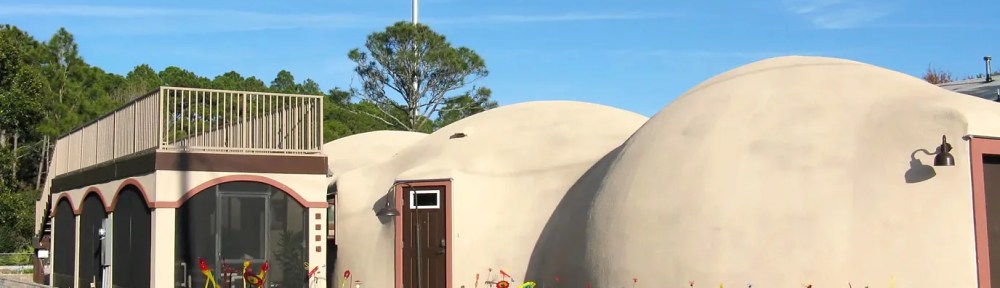
In 2018, Hurricane Michael became the first category five hurricane on record to make landfall in the Florida Panhandle, sweeping entire buildings off their foundations, and affected almost 50,000 structures.
But Margaret Clayton’s dome, “Golden Eye”, was fine. She had designed and built it in 2015 in a small Gulf-front community, with a construction company called Monolithic Domes.
“I was not a bit afraid during Hurricane Michael,” she said.. “A South Florida newspaper said there were sustained winds of 185+ mph and gusts of 201 mph. I believe that as I watched the neighbor house explode and saw trees twist and fly apart. Debris pounded the dome viciously. My hurricane windows were fractured but held so no rain entered. My large hurricane garage door held, but was a bit bent at the bottom as it faced the full force of the hurricane. All the homes around me were destroyed or are uninhabitable. Except for the transformer and a board which wedged in the dome—like a spear or javelin—GOLDEN EYE is fine. The other side of the dome is perfect! Living in a dome is a dream!”
“Even with no air conditioning, the dome was pleasant. We had no electricity for a couple of weeks. I urge everyone to build a dome home. My dome is one street off the beach, and I knew I needed a strong structure to survive a hurricane.”
She wrote a story about her house in November 2018, after reading Monolithic Domes’ story about it.
“I loved everything about the domes and was so impressed by everyone at Monolithic! So I located a lot on Beacon Hill by Mexico Beach, Florida—because I wanted to be near my brother, John, who is now deceased. Although I miss my brother every day, I have loved living in my dome I named GOLDEN EYE.”
“When my husband—deceased also—and I lived twice in Bermuda in the 1960’s all the homes were named. There were no street names or numbers for mail. Just your home’s name and the parish in which you lived. Monolithic let me completely design GOLDEN EYE and I love living there.”
The homes around hers were destroyed or were uninhabitable. Her neighbour, who used to make fun of her caterpillar-like home, sheepishly said, “I will never make fun of your home again!”
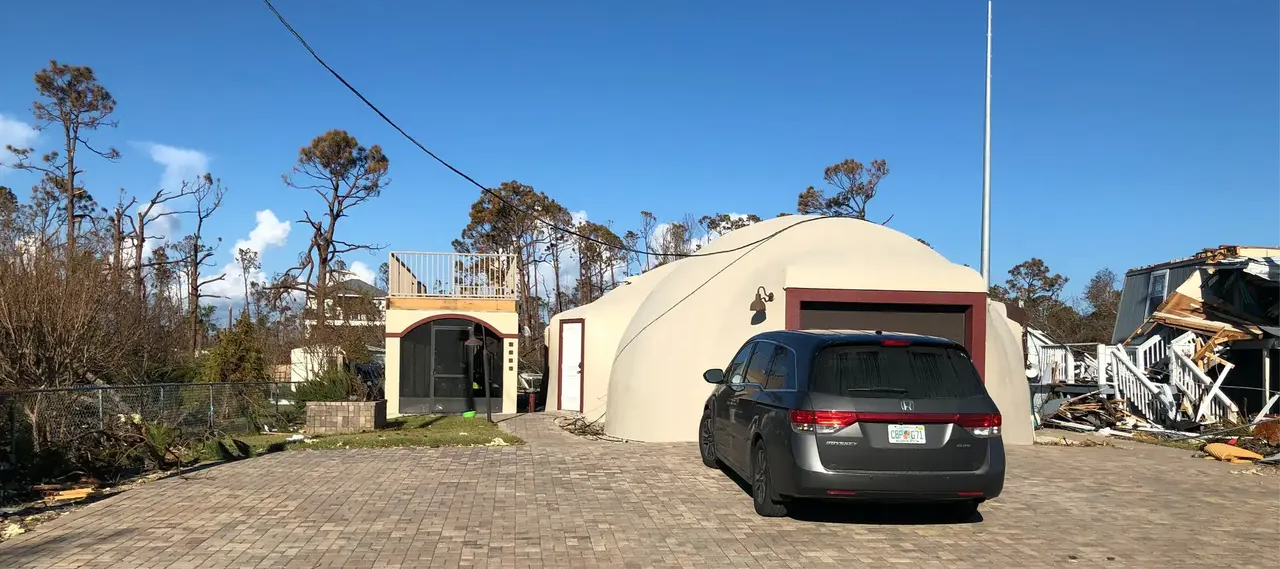
“The wow factor comes when you see those photos,” Landolf Rhode-Barbarigos, an associate professor in the University of Miami’s civil, architectural and environmental engineering department and associate director of the Climate Resilience Institute, told the BBC. “Total destruction next to a dome house that’s still standing. It’s quite impressive.”
The first Monolithic Dome structure was built in 1976, as a potato storage unit in Idaho. Now the domes can be found across the world, from the Arctic to the tropics.
When David, Barry and Randy South switched on the inflator fans to construct the first Monolithic Dome in April 1976, it changed their lives. Today, there are Monolithic Domes throughout the US and the world—from the Arctic to the tropics—used for schools, storages, churches, homes, gymnasiums, safe rooms and more.
There are domes as small as 8-feet to over 340-feet diameter with engineering for even larger structures. They have withstood major earthquakes, powerful tornadoes, raging fires, direct hits by hurricanes, and fiery explosions. Monolithic Dome owners report energy savings greater than 50% over conventional structures. Often they are less expensive than traditional structures.
“The interest in domes fluctuates,” says Gary Clark, who leads dome-building workshops in Texas – and lives in his own domed home in Michigan.
The buildings are constructed from concrete and steel, starting with a circular ring beam on the floor of the structure. An air form membrane made of PVC-coated fabric is attached to the ring beam and inflated to create the shape of the structure. Closed-cell polyfoam is applied to the interior, and steel reinforcement is attached to the foam surface, which is then sprayed with layers of concrete known as shotcrete.
Since 1980, hurricanes have caused more than $1.3 trillion (£993bn) in total, with an average cost of $22.8 billion (£17.4bn) per event. As of 2023, they had caused 6,890 deaths.
“This type of [climate-resilient] architecture combined with the right engineering solutions could save lives in the face of extreme weather,” says Rhode-Barbarigos. “We need to explore building more climate-resistant structures because we know that certain forms are better for certain environments.”
“Hurricane-resistant design is not a unique idea, but the reality of ensuring that your home was properly engineered with the right connections and design considerations is a significant challenge. Most architects don’t design round houses,” says Steve Linton, president of Deltec Homes, which has built homes in all 50 US states and in more than 30 countries.”You need resilient homes to adapt to the changing world we find ourselves in.”
Time after time, storm after storm, our Deltec homes are left standing – and after Helene devastated our hometown of Asheville, NC, thankfully so are we, Deltec said. “Although our facility is near the French Broad River, luckily it is on high ground and escaped the devastating flooding. The catastrophic impact of Helene on our mountain community has only strengthened our commitment to building world-class weather resilient homes. Please reach out to learn more.”
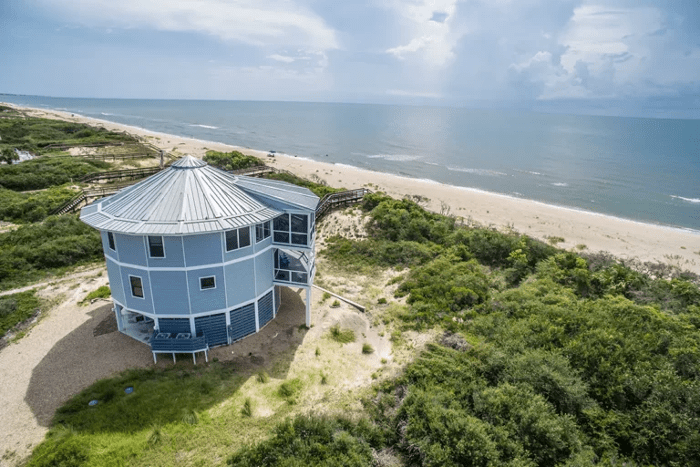
Of the 5,500 domed and rounded homes Deltec has built, only one has sustained damage from high winds despite facing some of the country’s most powerful hurricanes on record.
A circular shape means the home can absorb and distribute the energy better than a traditional house, regardless of the direction of the wind force.
“The conventional approach to making a home hurricane resistant is to take a traditional home design and reinforce it. It is like trying to make a race car out of a school bus – they really are just two completely different [things], and a home is no different,” Linton says.
The domed form has an advantage, Rhode-Barbarigos explains, because the homes don’t resist the flow of the wind around them. “A regular house with edges like a box, and a flat roof, that creates a certain obstacle to the flow of the wind,” he explains. “When you have a house that’s round, by default it receives less force from the wind. It’s not only the engineering but also the architecture that can affect the [wind] load.”
Sources:
Letter: Margaret Tells Her Story of Riding Out Hurricane Michael in a Monolithic Dome Home. Margaret Clayton, Nov. 5 2018
These Florida domed homes have survived category 5 hurricanes BBC, Oct. 17 2024
Images: Margaret Clayton. The middle image shows Golden Eye after the hurricane. The bottom image shows a home by Deltec Homes.
 Hopebuilding