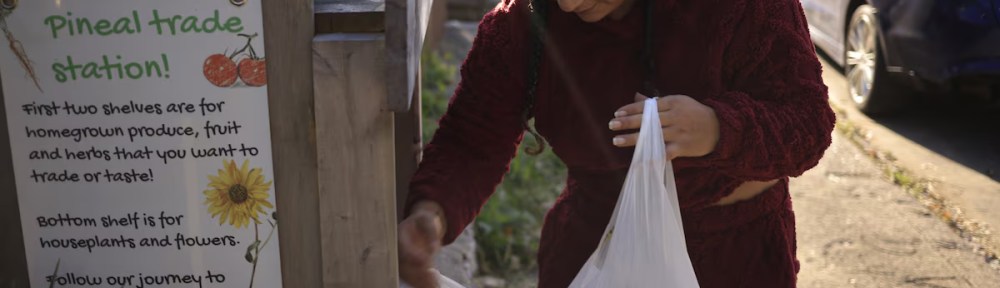
There are more than 50 community trade stations spread out over eight counties around Louisville, Kentucky, and stretching into Southern Indiana. Signs encourage people to leave any excess produce from their gardens on the shelves or take any they want. It’s like Little Free Libraries for gardeners.
“I was just doing people’s gardens, helping people do veggies, flowers, stuff like that and bringing them bees and butterflies and then it was like … if you garden, you’re going to have way too much stuff, too many tomatoes, peppers, whatever you’re growing … and instead of going to waste you can just trade it for something else,” says Noah Curtis.
He runs a landscaping company, Pineal, that works with homeowners and businesses. He was providing gardening services for customers when the idea of creating a produce and garden trade station occurred to him.
“I’ve always loved nature, I always wanted to start a business,” Curtis said. “I always wanted to do something that I felt like could change the world, where I could really do something.”
So he knocked some shelves together from cedar, in his dad’s driveway and set up the first trade stand.
Robby King, assistant director of enrichment programs at Dreams with Wings, a local nonprofit that works with individuals with disabilities, remembers that first stand on Harvard Drive.
“That seemed like a really neat idea,” King said. “It just seemed like a neat way to reach out and get the community involved and seemed like a cool thing.”
A few months later, King connected with Curtis to get a trade station at Dreams with Wings. Now, it stocks its trade stations with vegetables and other plants it grows in its garden.
“I think people always have all this extra food, a lot of people like to garden and grow food, and then you do it and you don’t always use it and stuff can easily go to waste,” King said. “So, I think one way it benefits is being able to not throw out food and there’s people who can actually use it.”
Paige Waggoner agrees. She has been gardening for 20 years and started homesteading with chickens and bees last year. She says that the Pineal trade station she hosts has been a “jumping off point” for communication with neighbors.
“I think it’s just important to have [food] be available to everyone and I’m not necessarily in it to make money,” Waggoner said. “It’s a way for people to share what they have in the plant world.”
The Pineal community is active on Facebook with gardeners across the area sharing what their trade stations will have available, asking for growing tips, and sometimes even searching for that last homegrown ingredient for a meal.
A Pineal trade station gave Derek Ernst a way to share his expansive garden and passion for healthy eating with others. He grows more than a dozen plants and foods, and keeps chickens and honeybees. He has already had a neighbor drop off goods and is glad to be part of something that helps his community be healthier.
Jazzii Hardin has a Pineal trade station in front of her house, and she grows vegetables to fill it for others. Her neighbors drop off their excess harvest for her station as well. The Washington Post calls her the Robin Hood of Louisville horticulture, because she monitors Pineal-related social media groups, and if she sees that one station has lots of produce or plants, she collects it and delivers it to a station in an underserved part of town.
The day the Post visits, she has harvested enough tomatoes to fill a 12-quart stock pot. “We drive to two stations in West Louisville, and she carefully arranges her tomatoes on the stand, then takes a photo and posts it on those social media pages. The basic message: Come and get it.”
One day, she was stocking the station when she saw a young boy running toward her. He wanted to get cherry tomatoes and he began popping them into his mouth as if they were candy.
“The smile on that kid’s face, that just changed it for me,” she recalled. “These kids see what you’re trying to do; they understand. I knew that I had to keep doing this.”
Each trade station has its own story, the Post notes.
“A woman in Elizabethtown resurrected an abandoned community garden and wants to share the produce. More than one gardener took up the hobby as part of their rehabilitation from addiction. Schools want to set them up as part of an agriculture program.”
Sources:
Kentucky gardeners fight hunger with little free produce libraries Washington Post, Oct. 31 2024
Neighborhood trade stations blossom, creating healthier communities. Spectrum News, July 8 2024
Meet Pineal, the ‘Little Free Library’ concept for locally-grown produce, plants & more Courier Journal, May 15 2024
Cover image: Jazzii Hardin delivers homegrown vegetables to a trade station in Louisville’s Portland neighborhood. Washington Post.

