Eniola Shokunbi is on a mission – to protect children and schools from poor indoor air quality by promoting the use of simple do it yourself air filters that the students can make themselves.
Now it has become a science project for students in Connecticut schools that also will improve their health.
Eniola is in eighth grade now but she’s been working on this since she was 10 years old and in fifth grade at the Commodore MacDonough STEM Academy in Middletown, Connecticut.
“A lot of my friends were getting sick with allergies and sicknesses,” Eniola said. She had the idea of conducting an experiment to see if better air quality improved student attendance, using the Corsi-Rosenthal box which was born after wildfire smoke and the COVID-19 pandemic caused a surge in demand for air purifiers.
She wrote to researchers at the University of Connecticut, proposing a collaboration. “She hand-wrote me a letter and I was so impressed,” said Marina Creed, the university’s Indoor Air Quality Initiative director and an adjunct instructor at the UConn’s School of Medicine.
After making the box, using materials supplied by the university, the fifth grade students decorated it and called it “Owl Force One”. Made from a box fan, four common furnace filters, duct-tape and cardboard, it is simple and inexpensive – it costs only $60 to make.
Researchers who tested out the box at home found it was very effective. Misti Levy Zamora, an assistant professor in the university’s public health sciences department, tried the DIY air filter in her home when smoke was impacting air quality. “The concentration reduced by over 95% within 10 minutes,” she said. “And then it maintained that low concentration throughout the wildfire event.”
Kristina Wagstrom, an associate professor in chemical and biomolecular engineering at UConn, says tests in occupied classrooms have shown particle levels reduced by about 60%. “That’s actually saying a lot, because you still have the students in the classroom creating new particles as this is going on, and it’s able to lower it by that much for such a simple intervention,” Wagstrom said.
The students, and the researchers, wanted to see how the box would perform against other DIY designs and off-the-shelf purifiers. Tested at the Environmental Protection Agency’s laboratory in Research Triangle Park, it removed 99.4% of infectious respiratory aerosols in 60 minutes.
“It really makes cleaner indoor air more accessible to a broader spectrum of folks,” says Katherine Ratliff, a physical scientist and principal investigator working under the Homeland Security Research Program in the U.S. Environmental Protection Agency’s Office of Research and Development. “If we’re talking about taking an air cleaner and putting it in every classroom in a school, for example, this is a much less expensive way to do that.”
“You can make it at home by yourself or you can make it with multiple people,” Shokunbi says. “It helps create teamwork, collaboration, stem, you learn about science and how it works.”
“A key component of my mission is to involve students directly in the process by having them build the air filter boxes themselves,” she says. “This hands-on involvement will provide educational benefits in STEAM fields while also fostering leadership skills and raising awareness about environmental health.”
“Ultimately, my goal is to create healthier learning environments for all students while empowering them with practical skills and knowledge to make a lasting difference in sustainability.” She aims to take the initiative nationwide.
“We looked at the lab results and we knew we had something special so we partnered with our school of education to create lesson plans so that this is essentially a science project for Connecticut schools that takes only 30 minutes, $65 and has a tremendous public health utility,” says Creed.
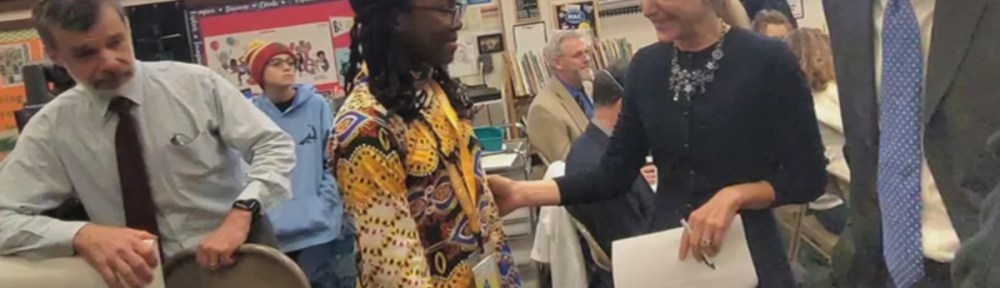
Shokunbi was in the room as the State Bond Commission unanimously approved $11.5 million for the construction and installation of the air filter system for other schools in the state. The funding will go to University of Connecticut as part of the school’s Supplemental Air Filtration for Education Program.
“A lot of people, they don’t realize sometimes, that the only thing standing between them and getting sick is science,” Shokunbi said. “If we’re not investing in that, then we’re not investing in the kids’ future.”
Traditional filtration systems cost thousands of dollars.
Sources
Fanning forward | State Bond Commission in CT approves $11.5 million for Do-It-Yourself Air Filters Fox 61, Oct 23 2024
EPA testing DIY air purifier built by fifth graders WRAL, July 27 2023
 Hopebuilding