
This wonderful story, from the International Organization for Migration, was originally published July 1, 2026, under the headline “How Bosnia and Herzegovina’s National Football Team Became a Symbol of Belonging.” It was written by Majda Balić, Media Specialist with IOM Bosnia and Herzegovina. The photographs are from the website of the Bosnia and Herzegovina Football Federation
Every four years, football reorganizes the world.
Streets fill with jerseys, cities pause for kick-off, group chats light up across time zones, and the fans’ attention narrows to line-ups, last-minute goals, and the loudest cheers. Suddenly, people scattered across continents are reacting at the same second to the winning goal.
The match may be played far from home, but the stadium stands tell a different story. Flags wave, songs echo and for a few hours, the entire stadium feels like home.
As the world watches the FIFA World Cup, football becomes a global language and reflects a world shaped by movement, bringing together people, history and diverse cultural identities. Across this year’s tournament, 289 players are representing countries where they were not born.
But few stories capture the emotional power of migration as strongly as Bosnia and Herzegovina.
Situated in Southeastern Europe, in the Western Balkans, the country carries a long history of migration. The Bosnian war of the 1990s forced families to flee, scattering people across Europe and beyond. Many found safety and built new lives in other countries, forming a global diaspora that remains deeply connected to its homeland.
For decades, Bosnians living abroad have maintained close ties to Bosnia and Herzegovina, sending remittances home each year to support their families, local communities and the country’s economy. Many have also preserved their language, traditions and identity across generations, ensuring that their connection to home endures despite the distance.
The story of migration is visible on the football pitch at the World Cup. A total of 17 of the 26 national team players were born outside the country, in places such as Germany, Austria, Sweden, Denmark, Switzerland, Slovenia, Croatia, Serbia and the United States. They grew up in different systems and societies yet continue to share a strong connection with Bosnia and Herzegovina.
Players like Sead Kolašinac, Kerim Alajbegović, Ermin Mahmić, Benjamin Tahirović, Tarik Muharemović and Esmir Bajraktarević show how this global diaspora has become more than a source of talent. It represents a living connection between Bosnia and Herzegovina and its communities around the world. Their careers show how migration can foster talent, skills, resilience, unity, and pride.
Reflecting that sense of connection, national team head coach Sergej Barbarez has rallied players and fans around a simple message: “Dream big. Dream BiH.”
National Team Director Emir Spahić expressed a similar sentiment, describing the search for talented players abroad as reconnecting with the country’s own people rather than recruiting from elsewhere.
“We are not taking anyone away from another country. We are simply bringing our children home.”
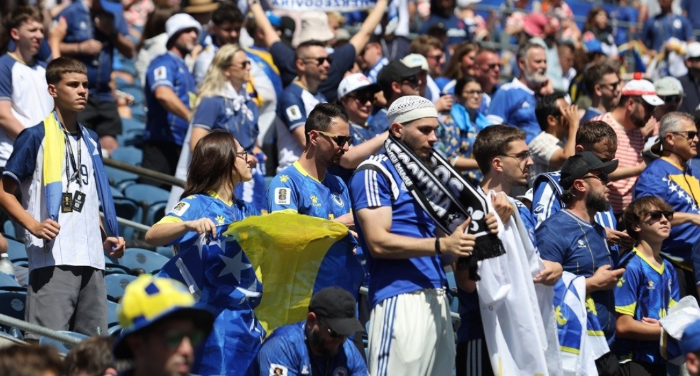
The war scattered people. Europe and the world raised their children. Today, football has become one of the ways Bosnia and Herzegovina reconnects with them.
The same story unfolds in the stands.
Because of decades of migration, Bosnian communities are present around the world. When the national team plays abroad, it rarely feels like an away match. Fans fill stadiums from Stockholm to Los Angeles, turning foreign cities into places of memory and connection.
For those who moved under difficult circumstances, supporting the national team is a way of saying: “We are still here. We still belong.”
Bosnia and Herzegovina’s national team offers a powerful example of what migration can create.
It shows how people can build lives in new countries while maintaining strong connections to where they come from. It shows how identity can grow across borders and generations without losing sight of its roots.

